



Women have babies at different ages. We can measure using any number of units. One way we should not measure age, with regard to births, is by dichotomizing it into “teen” and “not-teen.”
News from the Washington Post is that, “Birth rates among teens and young women hit record low in 2022, CDC says.”
The story quotes my colleague Feinien Chen, who is (as far as I know, always) right: Teen births are part of the broader cultural trend. I would add a stronger statement: Teen births are a myth. They are not a social phenomenon. They are just births to women in their teenage years. There is no separate thing called a teen birth. Or a teen birth rate.
This is what I mean by teen births are a myth. I don’t see in the figure below, or in the research more generally, that teen births exist as a meaningful category with their own social dynamic. This is birth rates by age, comparing 2017 the new CDC data for 2022).
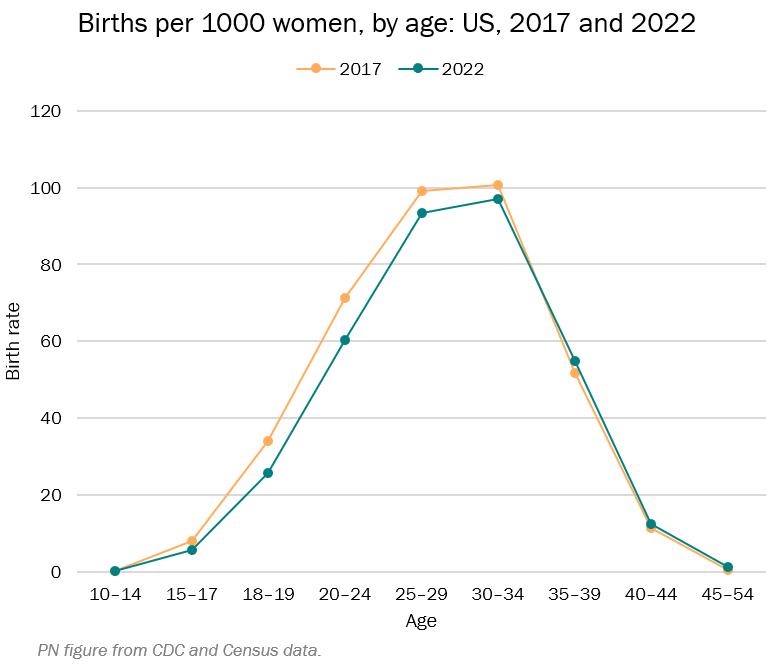
I’ve been beating this horse for years (of course). I said in one of the more recent posts: “Teen births have fallen as people increasingly delay childbearing and marriage. Falling teen births are simply part of the historical trend on marriage: rising age at marriage, declining marriage rates.” This matters to me because the bologna salesmen trying to promote marriage like to talk about how the “campaign to prevent teen births” (which was about unmarried women, of course, because married teens are super OK) is a model for successful government intervention against historical tides. In fact, that campaign just coincided with the trends already underway. (That post also includes some crude statistical analysis showing teen births vary with other changes in the age distribution of births.) That doesn’t mean the government doesn’t have a positive role to play — sex education and health care, including comprehensive reproductive care, including abortion and all manner of contraception — is extremely important and does play a role here (and we should do more, as our level of unintended pregnancies and births, especially among young people, is still unacceptably high).
Finally, It’s not necessary to get into this, but the issue with “teen births” also has to do with the categorical problem of defining “woman.” The history of “teen births” is partly about people who are too young to have (sex and) children. If a 14-year-old has a baby people say, “it’s children having babies!” I would counter that, to the extent she’s having a baby, she’s a woman (which goes for transmen, too). Does this mean I oppose age of consent laws, or deny the existence of childhood? Of course not. It just means you shouldn’t pretend your fixed social or biological categories so cut and dried.
—
Previously Published on familyinequality with Creative Commons License
***
You Might Also Like These From The Good Men Project
 |
 |
 |
 |
Join The Good Men Project as a Premium Member today.
All Premium Members get to view The Good Men Project with NO ADS. A $50 annual membership gives you an all access pass. You can be a part of every call, group, class and community. A $25 annual membership gives you access to one class, one Social Interest group and our online communities. A $12 annual membership gives you access to our Friday calls with the publisher, our online community.
Register New Account
Need more info? A complete list of benefits is here.—
Photo credit: iStock


I disagree. In my not so humble opinion, most pregnancies in women not yet in their twenties or later are unwanted pregnancies. Most of them are damaging to those females, both physically, and financially. We, society, needs to provide those females with better education, birth control, and often just someone who care about them as people. Those behaviors will reduce teen pregnancies and will improve the lives of those women.