



Gill Kernick saw the Grenfell Tower burn in 2017 from the Trellick Tower. After her return to the UK in 2011, she and her husband had lived on the 21st floor or Grenfell for three years. Some of the 72 people who died in the fire had been her neighbours.
She has also worked internationally as a consultant specialising in recovery from disaster. Her book Catastrophe and Systemic Change seeks to learn the lessons from Grenfell about preventing catastrophes. It is a substantially revised version of an earlier edition that is now able to draw on the 1,700 pages and seven volumes of the Grenfell Tower Public Inquiry, which was released in September 2024.
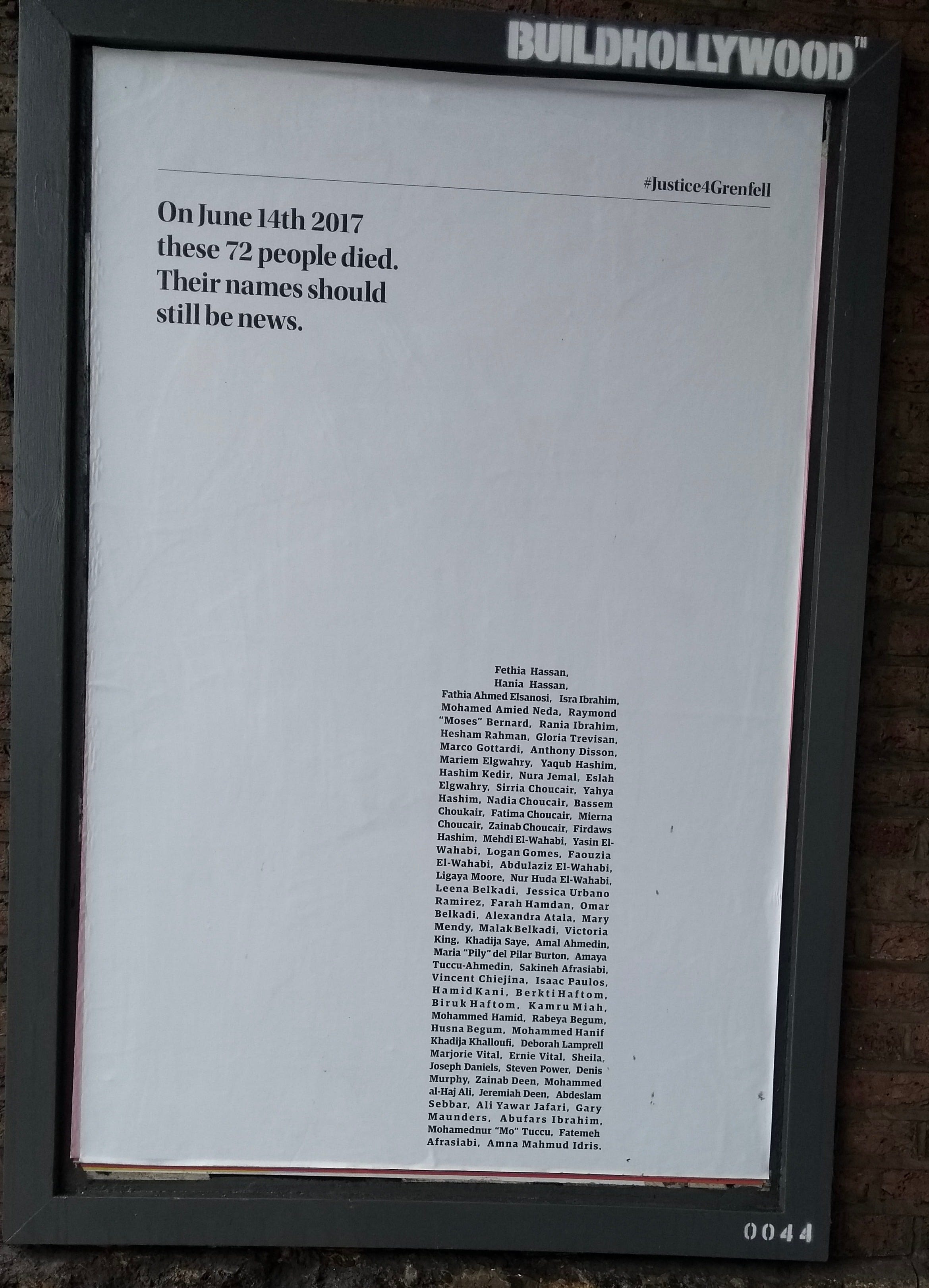
The book isn’t just about Grenfell. It draws on a wide range of disasters, including, for example, Challenger, Chernobyl, Hillsborough, Boeing’s 737 Max crashes, and the Post Office Horizon software scandal. And, intriguingly, also the great Fire of London in 1666.
Deaths foretold
But Gill Kernick wrote the book with the shrouded Grenfell Tower literally in sight of her flat. And while it would be easy to drown under the weight of all this material, Catastrophe and Systemic Change is clear, readable, and even quite compelling. I read it over a long weekend.
I have written about Grenfell here before, in multiple posts, and I am not going to rehearse those posts here. But it is worth noting that the incident that started the fire—which quickly became a conflagration—was a small kitchen fire “about the size of a waste paper basket.” In a well designed building it would have damaged the flat it started in, but no more than that.
But the Grenfell fatalities are a chronicle of deaths foretold. They are foretold in the coroners’ reports from other tower block fires. They are foretold in the reports from the House of Commons all-party MPs’ group on fire safety. They are foretold in the instruction from the London Fire Brigade to the Tenant Management Office to correct fire safety issues in Grenfell, which were then delayed by the TMO. They are foretold in some of the emails to the TMO from residents, who were scapegoated rather than listened to.
Being ‘in the tunnel’
They are even foretold in some of the shocking emails from the cladding contractors that were surfaced as part of the Inquiry’s discovery process. But as Kernick reminds us, when trying to understand why a disaster has happened, we should not rely on hindsight. Instead we need to be “in the tunnel”: what could an informed person who wanted to act for the best have known at the time? The answer is: plenty.
Although she doesn’t mention it we see the same thing in other disasters. Bazerman and Watkins, in Predictable Surprises, list the litany of high profile reports across the 1990s concerned that terrorists might use planes as weapons in the United States. These are disasters, but they are not ‘black swan’ events.
Kernick followed the Grenfell Tower Inquiry closely, sometimes in person. Quite early on in the book she reflects on some of the things she’s learned about the Grenfell fire. One them seems to be her impetus for writing the book:
I had not foreseen that the system is perfectly designed to ensure we do not learn.
An increasingly complex world
Her initial assessment was that two principal failings had led to the Grenfell Tower fire.
Firstly, taking a narrow ‘slips, trips and falls’ view of safety and therefore not considering low-probability, high-consequence (catastrophic) risks distinctly; and secondly, a lack of leadership.
As she thought about it, she added a third:
a failure to understand how to operate effectively in an increasingly complex world.
Inquiries into other British disasters, such as Post Office Horizon, the infected blood scandal, and the British COVID-19 inquiry, confirmed this perspective. And this leads to a useful distinction early on between piecemeal change and systemic change.
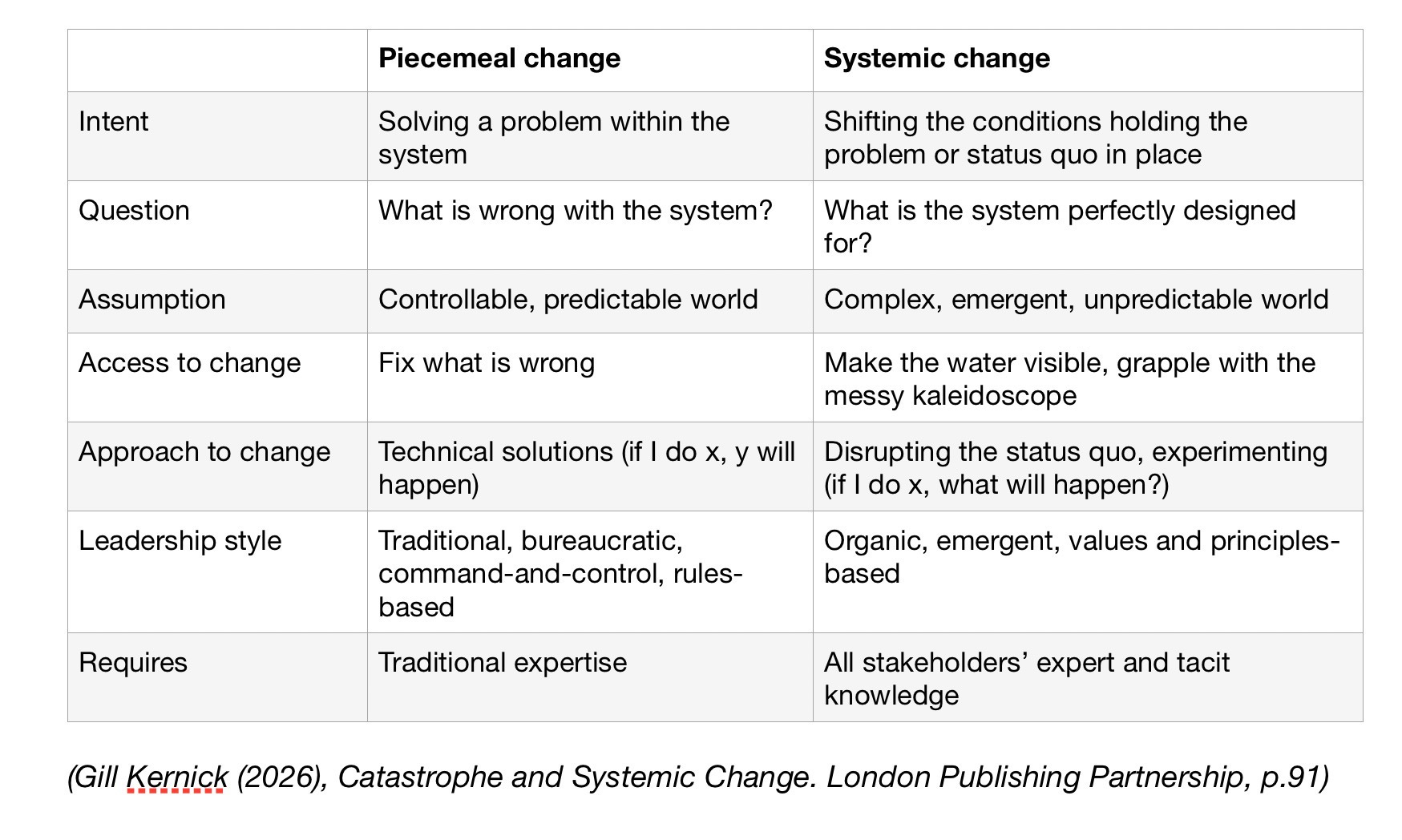
Piecemeal change impacts part of the system — building regulations, for example, or technical competency — whereas systemic change requires ‘shifting the conditions that are holding the system in place.
Piecemeal change
This is not to say that piecemeal change is irrelevant or unnecessary. Sometimes it’s the only way to ensure that bad actors act better. In the case of Grenfell, piecemeal change might involve banning contractors from using inflammable cladding on buildings. But it only improves behaviour, and outcomes, within the present system:
Piecemeal change is relatively easy: you identify what went wrong and then put plans in place to correct it. For systemic change, though, we need a different perspective. (p.92)
And it’s worth sharing a helpful table that helps to spell out the differences between them.
‘What the hell is water?’
So the question at the heart of the book, then, is one that has a wider relevance beyond catastrophe. This is: how to work with systems that don’t want to change?. To get to system change, you need to get beyond the visible. Kernick nods to Peter Senge’s paper ‘The water of systems change’, and builds on that with a familiar joke that she credits to a college commencement address by David Wallace Foster:
There are these two young fish swimming along… an older fish says to them, “Morning, how’s the water?”… and eventually one of them looks over and goes, “What the hell is water?”.
The book follows her intellectual journey, and she builds a sense-making model (below) to help her do this.1 The chapters unfold around these four areas of inquiry, and I’m not going to get into the detail of this here, because I think that the two questions are more valuable in thinking about both Grenfell and more broadly. As a working exercise, later in this piece, I’m going to try to apply some of the questions that she uses to the ‘black elephant’ disaster that is climate change.
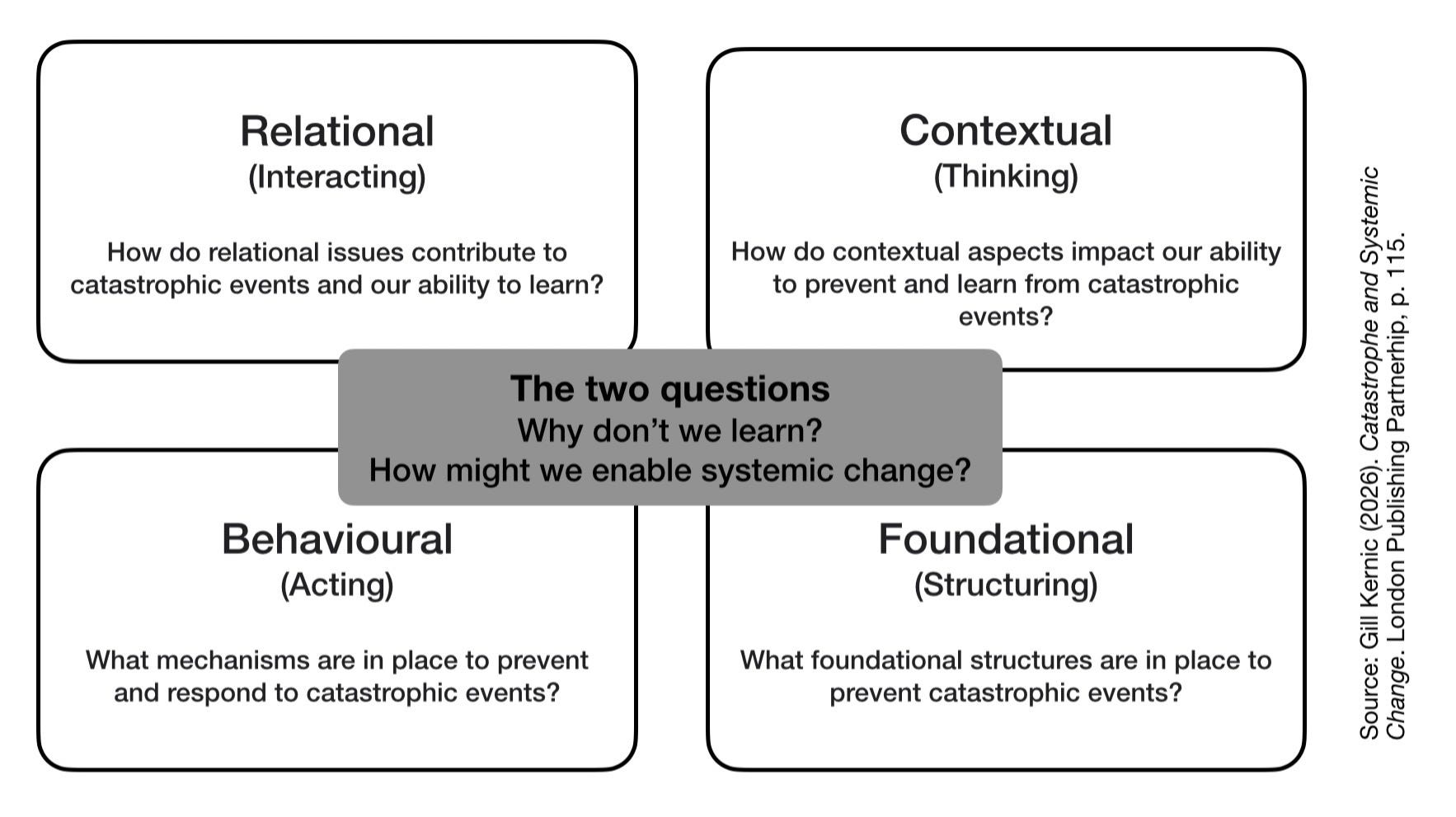
Obviously, when you look at this model, the difference between the bottom two boxes and the top two boxes is that the top both invite you to ask “what is it that we’re swimming in?”.
The latent and the active
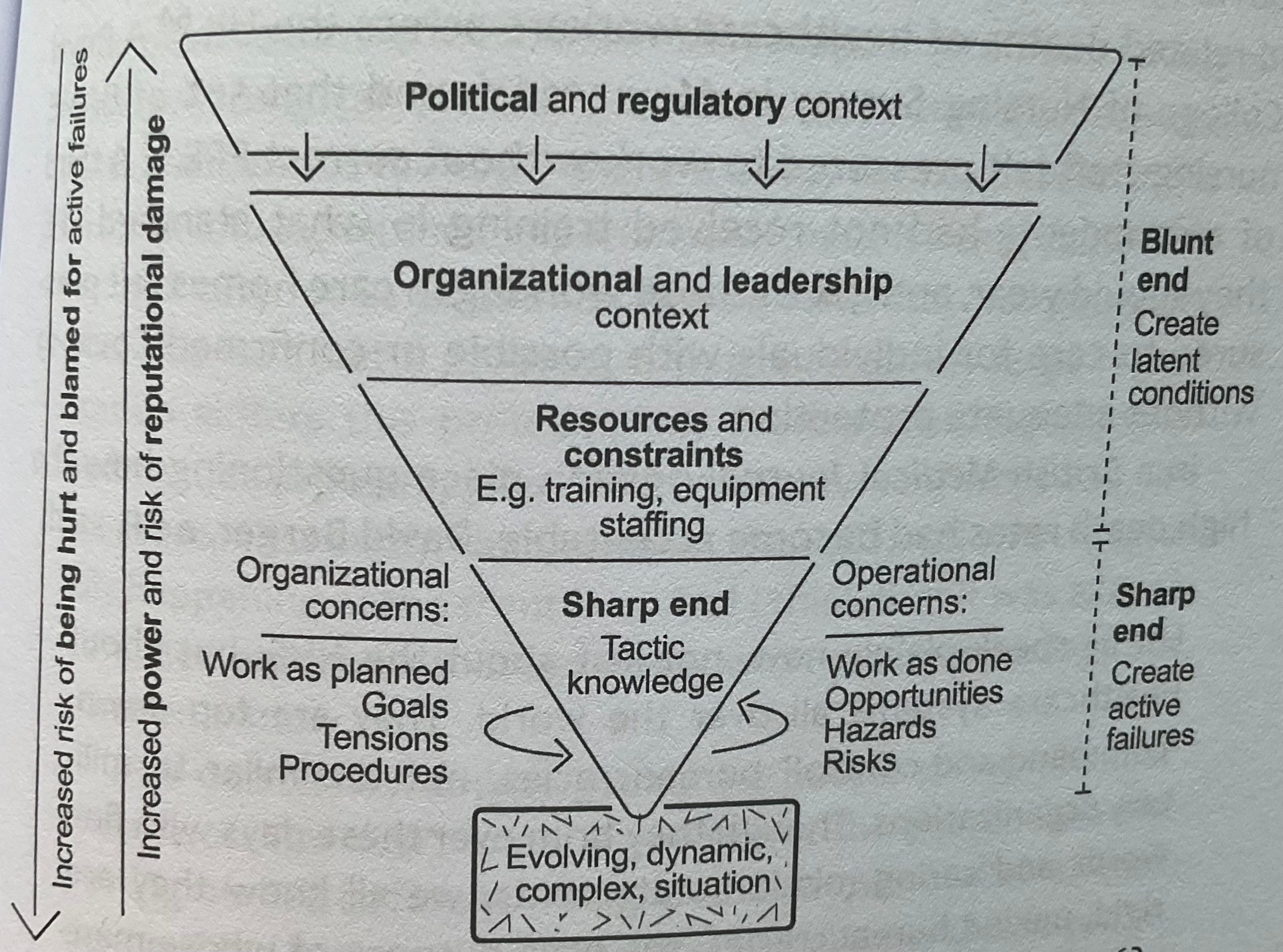
There are a couple of diagrams that help with thinking this through as well. The first characterises the difference between the parts of a system that create the latent condition for failure, and those that experience an active failure. I’ve been trying to turn these into nice digital diagrams, but it seems more useful to get this published and worry about that later. So here’s a photo of this from the book. (Note that ‘tactic’ in the bottom triangle should read ‘tacit’; I was going to correct this when I remade it.)
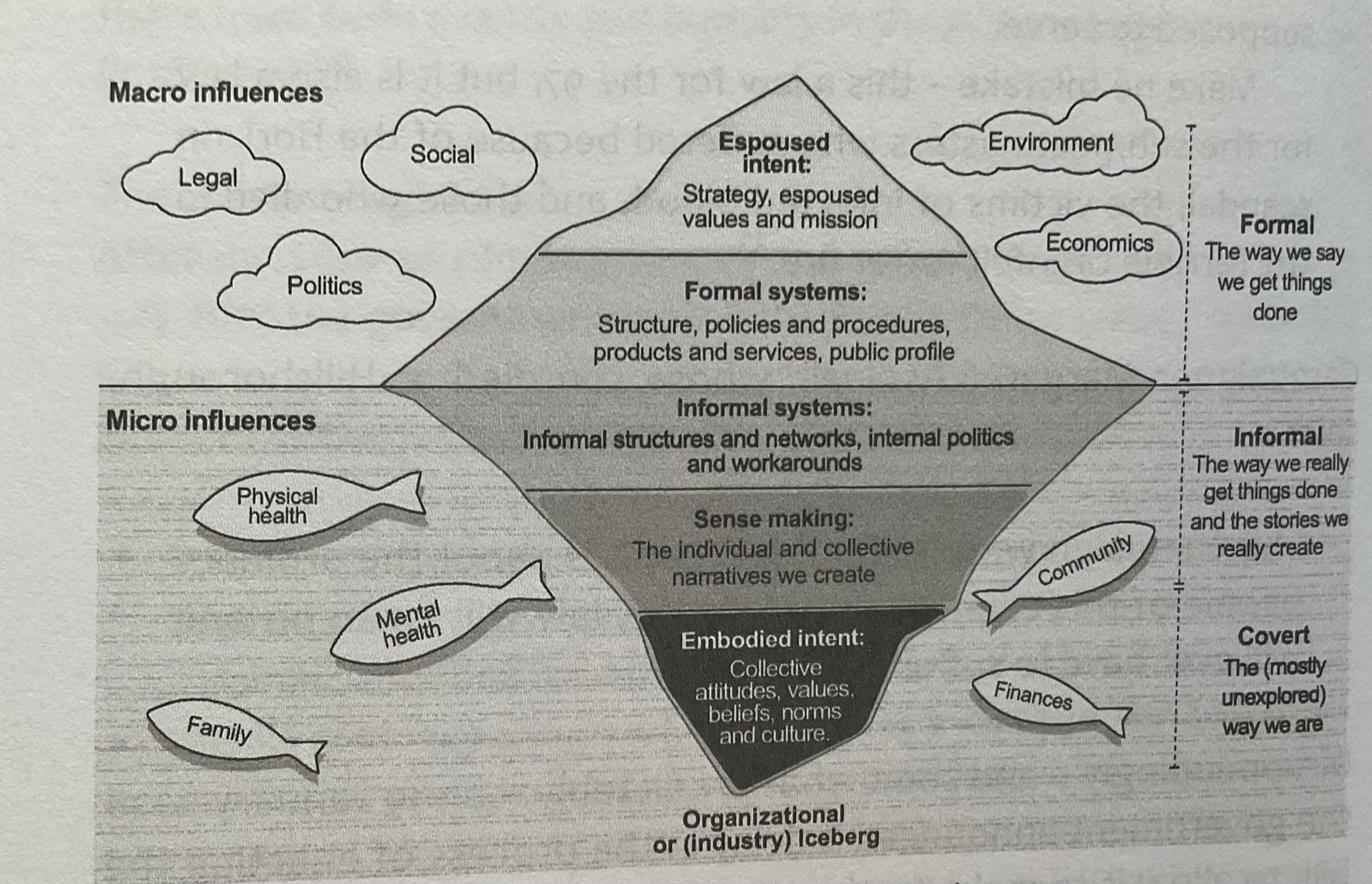
The second is an iceberg diagram, which she seems hesitant to include because “iceberg diagrams are over-used”, but I think this is useful here. Again, I haven’t managed to turn this into a clean digital diagram yet. If the diagram above is about the difference between the ‘blunt end’ and the ‘sharp end’, this captures the difference between the formal and visible, above the sea, and the informal and the embedded, sitting below the water line.
‘Look for the open doors’
In dealing with this, she was lucky to be mentored by Jim Wetherbee, who worked on the action plans following two Challenger disasters, as well as Deepwater and the Texas City Refinery explosion. His advice was:
‘The doors of the people who should be talking to you will likely be closed; stop knocking on them. Look for the open doors.’ (p.94)
The outcome of her journey is a fully worked model of change, developed from her sensemaking model, and named for Grenfell and its victims: The Grenfell Model of Change.
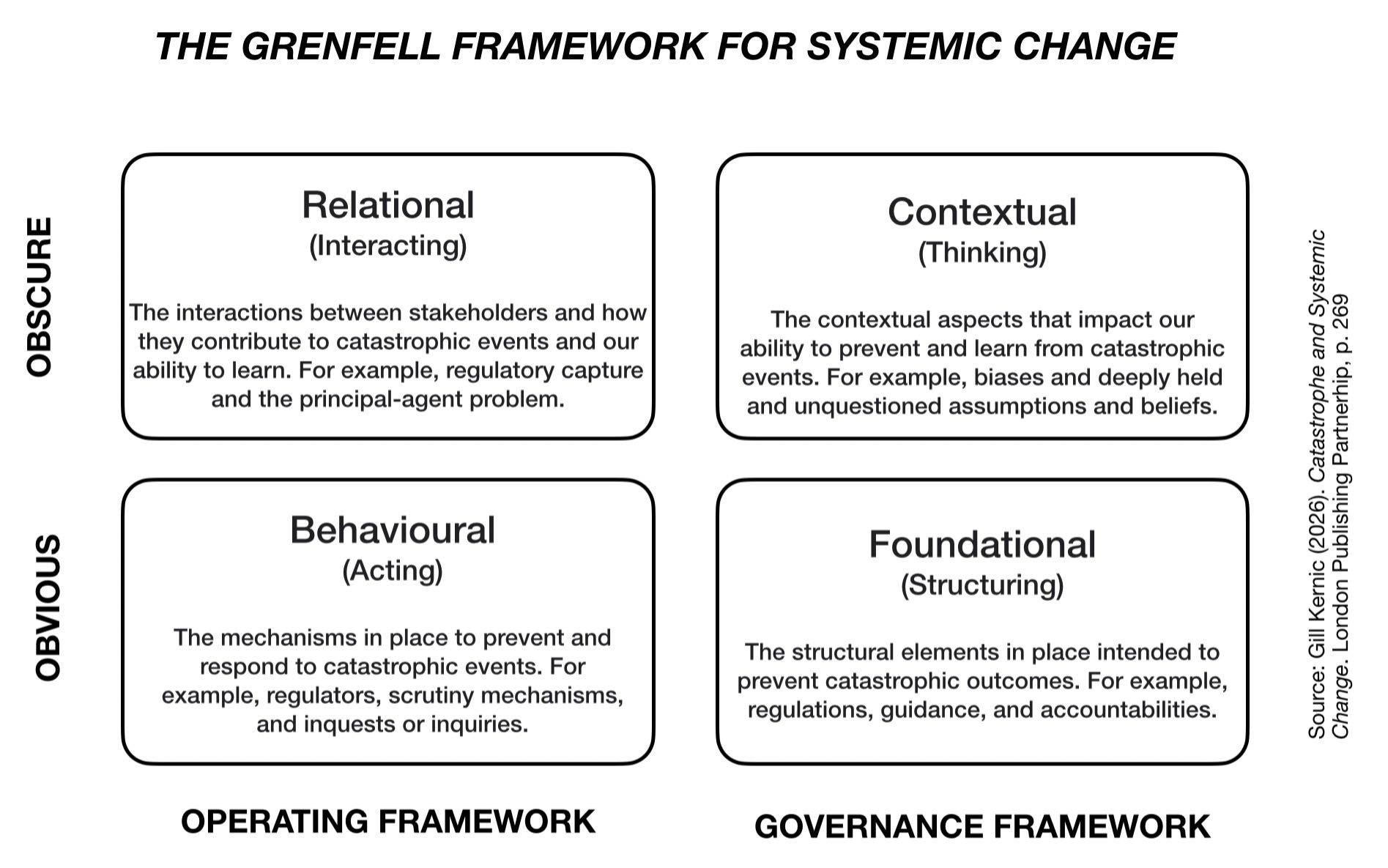
It’s worth noting the labels at the side and the bottom of the diagram. The ones at the side make a distinction between the ‘obvious’ (below) and the ‘obscure’ (above). The labels below distinguish between operating frameworks (left) and governance frameworks (right).
Framing some questions
In particular, reading slightly between the lines she frames a set of questions that help you to think about the two systems questions she posited earlier on: “why don’t we learn?”, and “how we might enable systemic change?”
One of the benefits of being a working futurist is that when you see an interesting model you can try it out in practice, and that’s what I did here, reading this section and distilling Gill Kernick’s thinking out to a set of questions for a group to use to explore a set of issues in a particularly intractable system.
- What system elements, rules, and organisations (formal and informal) hold this system in place?
- What are the current dominant mental models, assumptions, and ‘myths’ that are applied to it?
- Who gets blamed or scapegoated?
- What elements of change that you know of might disrupt the current system?
- What tensions might make this system unstable?
- Which voices are excluded or ignored from discussion of this system that could usefully be heard?
I can’t share their discussion, of course. But it did work. And that led me to think about how you might use it to think about a system such as the climate catastrophe, a classic “slow violence” disaster. So here’s a brief worked example.
Thinking about climate change
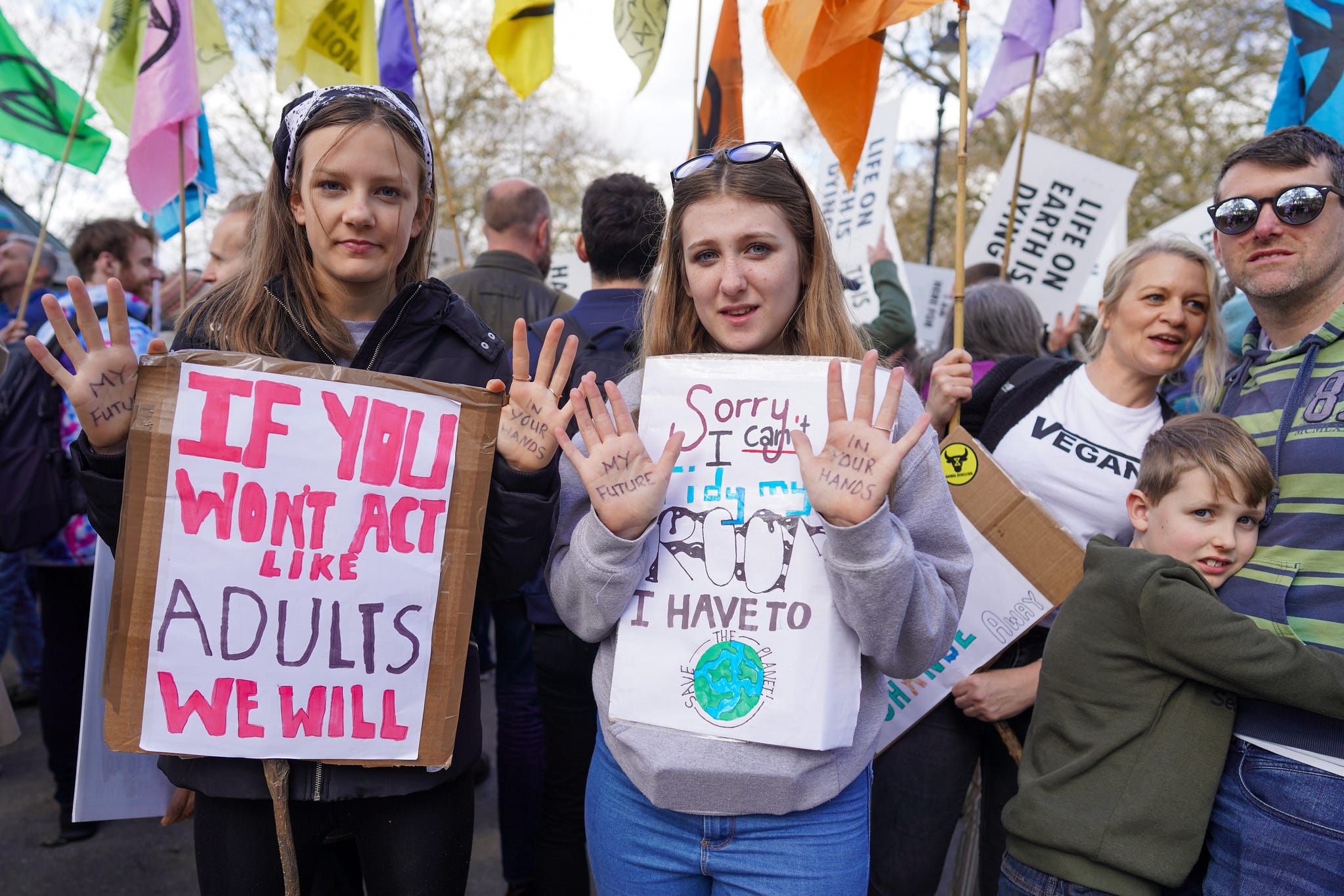
What’s holding the system in place? Well, as plenty of people have argued, capitalism is basically designed as a system that doesn’t care about the damage it does in terms of externalities. The current dominant mental models and myths are that technology will fix this behaviour and therefore we don’t need to change our behaviour. The people who get blames or scapegoated, in the UK, are the activists who try to make these first two features of the system visible: the many people who have been jailed as a result of Extinction Rebellion and Just Stop Oil protests.2
There are elements that might disrupt the system. The obvious one is the plummeting cost of renewable energy and rapidly improving battery cost and performance; the disruptions to the oil market caused by wars started by fossil-friendly autocrats might be another one. The tensions that might make the system unstable are the pressures on insurance companies caused by climate change, since, without insurance, capitalism stops working quite quickly. The voices that are excluded or ignored include, well, obviously, the Small Island Developing States. Closer to home, they include the majority of voters, who care about climate change, but are insufficiently vocal about it.
You could obviously map these on a Three Horizons diagram to track the conversation, with one or two small adjustments. The tensions lend themselves to dilemma resolution, sometimes used in conjunction with Three Horizons.
Communities of grief and change
As you can probably tell from this piece, it’s a rich book, and quite a moving one, with a lot of useful models as she works through the argument. It comes highly recommended.
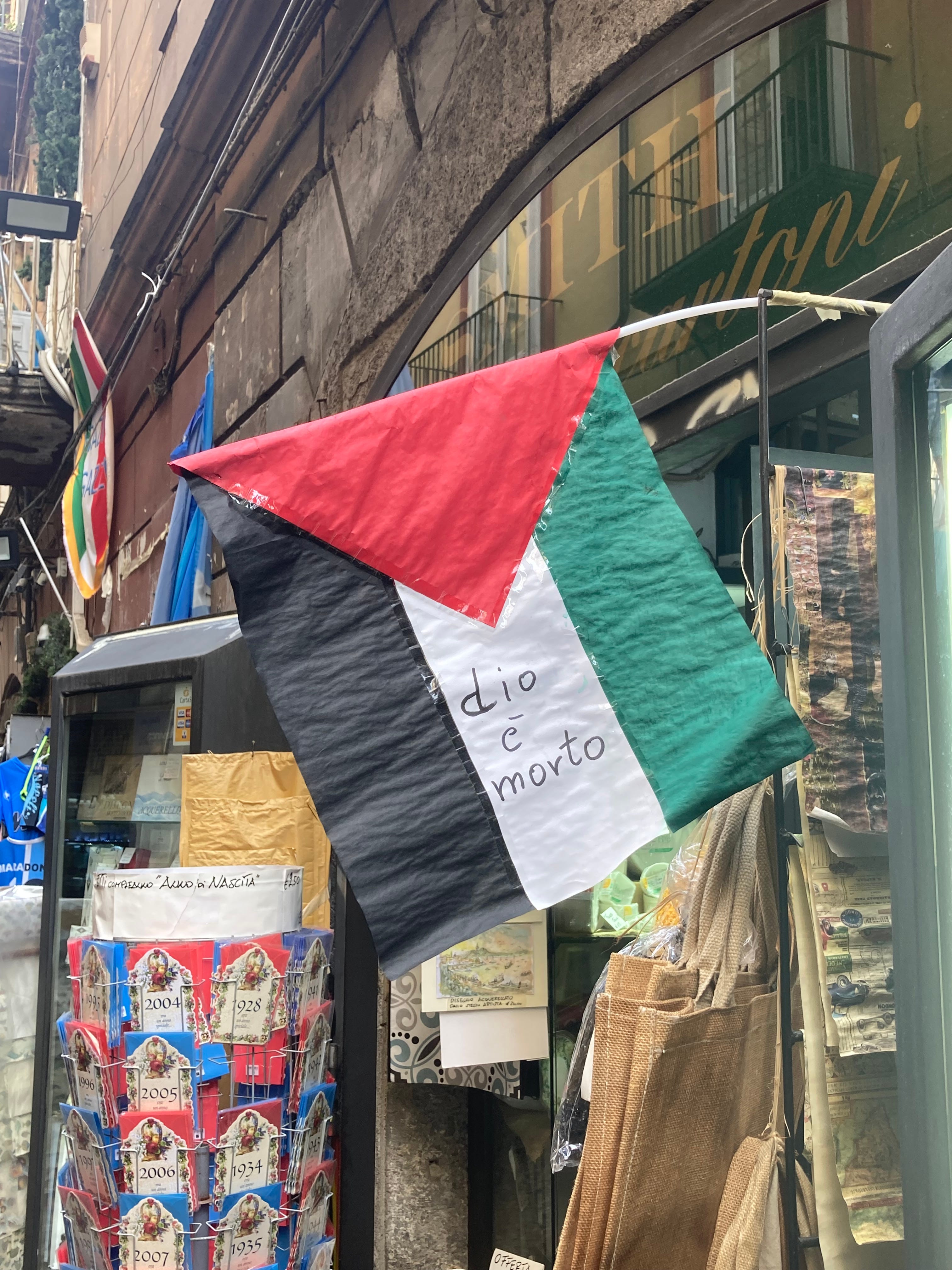
The next time I use the set of questions above, I might add an extra question to this list. One of the features that Gill Kernick writes about in the context of disasters is “Communities of grief and change”. These are the activist communities that emerge from the victims of disasters. Grenfell, Hillsborough, and Post Office Horizon have all seen these, and in the latter two examples they are the only reasons the victims of the disasters gained political and public traction. In slower moving disasters, like climate change, we might have to take steps to build those communities. In some, like Gaza, they emerge through protest camps, faith groups, and other forms of committed activism.
—
A version of this article is also published on my Just Two Things Newsletter.
—
Previously Published on thenextwavefutures.wordpress.com with Creative Commons License
***

If you believe in the work we are doing here at The Good Men Project, please join us as a Premium Member today.
All Premium Members get to view The Good Men Project with NO ADS.
Need more info? A complete list of benefits is here.
—
Photo credit: Global Climate Change/flickr

