



I have been a consistent underperformer as a runner throughout my 16 years as a competitive runner. I have run high school varsity cross country and track, and college varsity cross country in track in Division III. Since graduating college, I have moved up to become a marathon runner.
I was a choker in big moments when I should have run significantly better. I would run fast runs and destroy workouts as one of the best runners on my team in practice. But once the race came around, I would not run to the best of my ability, and run far below my potential.
As such, most of my time as a runner has been marred by underperformance. I still ran personal records in high school and college of 4:36 in the mile in high school, 9:53 in the 2 mile, 15:36 in the 5k, and 33:03 in the 10k. After college, I ran 54:58 in a 10 miler, 73:51 in the half marathon and last year, I ran 2:35:40 in the marathon.
Yes, for me, I think all those times, except the marathon, were too slow for my ability and the amount of work I was putting in. If it sounds like I’m being too negative, I probably am, but it comes with the inherent belief that I could do better, that I am better than how I have performed. I have gotten a lot more from running than running fast times — I have made my best friends who were best men and groomsmen at my wedding, grew up and discovered the person I am today, and built a lot of confidence in other areas of my life.
But while I’m young, I think it’s still something a large part of me wants to chase. I know plenty of people who are 40–45 years old running the times of their lives, which are ages I previously thought I could not run personal records anymore. However, I know that the best time to try to get good is now, when I ideally would peak as a marathon runner in my late 20s and early 30s. This year, my goal is to break 2:30 and hopefully run something in the range of 2:26–2:28 in the marathon.
Of course, it sounds silly when looking at it — I am devoting over 10 hours a week to run a couple of minutes faster for a very arbitrary distance of 26.2 miles. And if I don’t run those times or a personal best, it’s okay. But I do want to shoot for the moon and try to improve myself in that substantial way to prove to myself that I can do it and level up into a better version of myself, like I have for the last 16 years.
Recently, I have read Weldon Johnson’s “Why I Sucked In College.” I read it multiple times before, and it is a piece that documents why Johnson became a better runner after college and the different ways Johnson changed the way he trained and approached running. He documents doing his easy runs too fast, running too hard during workouts, and not having enough self-belief.
I have similarly made a lot of mistakes as a runner despite having been doing this for the last 16 years. What works for me might not work for you, but the point is, I had to learn my lessons the hard way, and I made a ton of mistakes. My stubborn nature holds me back, sometimes, more than it helped me grit through tough runs, workouts, and races. I have gotten better at running competitively despite spending the last three years busier than ever, working full time as a special education teacher while attending law school at night.
Here’s why I sucked at running until this past year, when I ran a four minute personal best in the marathon.
I didn’t run enough
This sounds like the most obvious thing — I did not run enough miles. I am a lot better now than I was in high school or college because more miles have made me a more efficient and faster runner.
80 miles a week would have seemed impossible in high school, unsustainable in college. I have a much stronger aerobic base now, and I realize that a big source of my fitness comes more from being aerobically strong instead of being super naturally talented or speedy.
A big strength is that I can run a lot without getting injured. This is a lot more of an asset than you would think. I can’t tell you how many extremely talented, better runners than me, who could have been the cream of the crop in NCAA Division I, have their whole running careers derailed by injury. I saw them agonize through endless stress fractures or have to spend quite a significant amount of time in the pool, on the bike, or on the elliptical, building fitness because they could not run. Those same people, more often than not, came back looking like they never missed a beat, but there was always the question for them, more than anyone else, of how much better they could have been if they could stay healthy.
I can’t tell you how many of those teammates throughout high school and college really just don’t run much, if at all anymore. To be constantly injured, well, sucks. I know one person who was incredibly fit and fast, who, when healthy, was easily the fastest person on my team. The problem? He was injured maybe half the time. I could not read minds, but being injured, not being to do all the things teammates could do was pretty tough psychologically. And once he was no longer chasing running personal bests and suffering through agonizing injury after agonizing injury, he had so much freedom to chart his life in a whole new direction.
Thus, the most I would run in high school was maybe 55 miles a week. The most I would run in college was 70 miles a week. I say most because I would hit those miles maybe once or twice a season before dropping down to a lower average miles. I followed the instructions of my coaches, but I am better now because I am running more miles, and when I was in college, I ran 5ks and 10ks.
Now that I run marathons, I need to run more miles, but also how I spread out my miles throughout the week has also changed. I don’t just run 12 miles every day. Instead, I run 7 miles here, 13 miles there, and even take a day off a week sometimes. I do long runs of 20–24 miles every week. I don’t do workouts that are that fast or faster than the pace I would run for a 5k. A lot of my workouts are either at a marathon pace or a pace I would run for 10 miles (threshold pace) given what I am training for.
But high mileage is not enough — there is another factor that has helped me improve substantially as a runner.
I was not consistent
Often, during training in the summer or other points of running, especially early on, I would run a lot one week, and then not run a lot the next. In particular, during my first two years of law school while working full time in special education, I ran 70 miles one week and then 30 miles another. My mileage charts would look like mountains based on that inconsistency. The why behind it was obvious — life happened and I got busy, and I didn’t have time or the energy to be running 70 miles every week.
But I also think a big reason behind my inconsistency was that my view of my running was far too narrow. I used to overvalue the importance of a single workout or long run. If it was a good workout where I hit fast splits, then I was going to run huge personal records and was on top of the world. If it was a bad workout, then I needed to scale back and needed some time off, and I would also think too much about how I felt on any given easy run.
Overemphasizing a single run or a single week’s mileage was too narrow because instead of thinking about a single run or week, I needed to focus on the long-term training cycle of a month or every three months. If I was running 70 miles one week, 30 the next, 20 the next, then 70 the week after that (a typical cycle two years ago), that meant I was only running around 190miles that month.
I could run that much in college and maybe still run a pretty solid 5k, but for the marathon, that was not going to cut it. On workouts, I had to start recognizing not how I felt on that given workout, but how my effort on that day would impact me the rest of the week. If I were going into the well and doing something that would absolutely cook me for several days, I needed to scale back. Instead of running really hard on a workout or running the last rep incredibly fast, it was better to just cut the workout a rep short so I could be fresh later in the week.
For six months last year, I ran 60 miles a week almost every week. I took a down week of 45 miles every here and there, but that meant I was averaging about 250–260 miles a month. The six months in a row part is a lot more important than the 60 miles part. Long term, consistent mileage is better than a single week or month of a really impressive flash in the pan.
There are a lot of training philosophies out there. Some people believe in not doing that much mileage, but having a lot of intense, speedier workouts. Others don’t run that much mileage but supplement with a lot of time on the bike or in the pool to build aerobic fitness while not having the constant impact and injury risk of running high mileage. I know triathletes who are always very fit at running, despite not running that many miles per week, because they’re always aerobically fit from their time doing other events.
There are different things that work for different people, but even if someone is running 25–30 miles a week, the key is to do this consistently, for a long period of time. A 16 week cycle of being able to run 30 miles a week is much better than running 50 miles one week, and then taking the next week off because you had a really busy week of work (life happens and we could all fall into this pattern).
Also, for me, there are two factors that makes not a lot of mileage but a lot of intensity not work like it does for other people. My friends and teammates who fell into this bucket tended to train for distances that were shorter than what I was running — 800 meters or the 1500 meters. Additionally, they could have been on much lower mileage because they had a problem that didn’t afflict me as much: injuries. There is no worse stalling of fitness growth or training than injuries, particularly the ones that can take you out for long periods of time, like stress fractures.
I have run 80 miles a week, at least, the past 16 weeks. My body has felt fine with no aches or pains beyond the soreness that comes from that volume of distance. But if I were more injury prone, I would have to be much more cautious in how I build up mileage, how much I do in my running versus cross training on the bike and pool. Once a big race comes up that I’ve trained a whole cycle for, I gradually off the miles for the two to three weeks before the race.
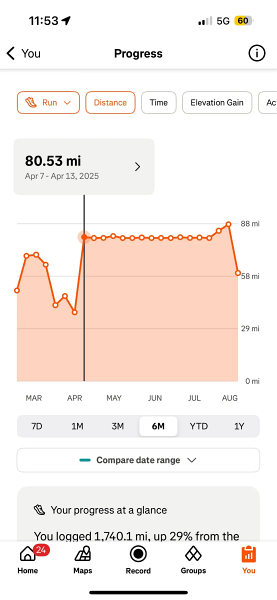
All of this is to say running 80 miles a week every week, and 60 and 70 before that, has worked to make me a better runner. But that might not work for you and other people out there — so much of what “good training” is to become better at running really depends on the person.
But the core principle of long-term consistency stands — whatever someone can maintain for a long period of time, even if it’s a new runner starting out at 10–15 miles a week and building from there, is the key.
Also, one week where I had a lot going on and could only run 60 miles (like this week) isn’t going to completely trash my fitness and training because I am more focused now on the long-term training. In fact, it’s good to take a week of slightly less mileage every once in a while to recover.
I should also make the point that a long-term vision also takes into account years. I would predict the runner who runs 30–40 miles a week and has been doing that for years is running better than the person running 80 miles a week, but has only been doing that for the last four months just based on the physiological adaptations and experience.
I have been running for 16 years. The years in high school where I failed to run more than 55 miles, the years in college where I failed to run more than 70 miles, and the inconsistent years where I would rotate 70, 30, 20 mile weeks all built the foundation for me to be able to handle 80 mile weeks as well as I do now. Even if a whole year is a disappointment in performances or injury, I have learned it still gives an incredibly strong head start next year.
I had terrible tactics
One of my coaches in high school gave advice that sounds so obvious, yet wasn’t advice I realized until then.
Run the tangents in your races. Run the least amount of distance possible. If you’re running in a race, until positioning really matters, run on the inside of lane 1.
Lane 2 is 7.037 meters longer than lane 1 on the track. Sometimes, I would run my whole race in lane 2 or even lane 3, continuously running longer distances. I would run slower times, of course, because I was running a lot more distance.
That coach also gave me some advice on something that was zapping my energy in the race: surges. Every time I ran through a big crowd of people, I would throw in a huge surge because I derived energy from the crowd around me.
Often, the guy who wins a major championship race isn’t the person who is in the best shape. I find, watching championship races, that it’s sometimes not the person who has the best personal record going into the race that wins track distance races, especially if they lead most of the race. The person who often wins is fast and obviously is one of the best runners in the world, but they do one thing better than the rest of the field: tactics.
Watch Cole Hocker’s 1500-meter Paris Olympics victory. He doesn’t go to the front of the pack until the last 30 meters, and conserves energy as he moves up the pack the whole race. The race goes out at world record pace, and instead of trying to match the leaders, Hocker holds back.
Or, watch Jakob Ingebrigsten’s 5000 meters 2024 Paris Olympics victory. Ingebrigsten is known for his “double threshold” training and the Norwegian method of training, which he has been doing since he was a child. His training means, on a given day, he could just be the most fit person in the race. But Ingebrigsten stays in the pack and seems to just chill for the vast majority of the race. When another runner makes a move with 600 meters to go, Ingebrigsten stays calm, and does not go with the move, but slowly and slowly reels him in. He runs his own race and finds another gear to destroy the whole pack in the last 200 meters, with no one able to challenge him.
Watch Joshua Cheptegei’s 2024 Paris Olympics victory in the 10000 meters, where he stays close to the back of the pack until about 1000 meters to go, where he positions himself. With 500 meters to go, Cheptegei makes his move and then puts in a blistering finishing kick that no one else can match.
Again, in no way am I saying these guys are not fit and the best in the world. Most of the reason why these guys win is because they’re the best, but they also need to execute well on the day. Good tactics help showcase fitness and talent — with bad tactics, you can lose a race or the race can go awry very easily.
When I first started running, I ran each run to the point where I felt like I was going to die. I thought running was supposed to feel that way, and, yes, when first starting out, it often does feel that way. But I was pushing too hard, too early. I eventually learned that I should pace myself, and I would run the paces my coach assigned. Now, I just know what shape I’m in and try not to run faster than a certain pace at a certain point of the race.
Personally, since I stopped making stupid mistakes in races, like going out way too fast or making surges in races in response to what my competitors were doing, I have improved significantly. If they were going to zoom past me and drop me, instead of trying to force going at their pace, I would just let it happen. If I had something left in the tank later to pass them back, I would. If they were just better than me on that day and I would never see them again, then so be it. It took me quite a long time to build the maturity to not base my races on what others do.
I also got a feel for my body and how it should feel at certain points. I knew when I was pushing to a moderately uncomfortable level, but also when I was pushing beyond what I should. I knew the effort level that would completely zap my finishing kick versus the amount I should be pushing. It took a lot of experience to really be able to sense that zone.
The same goes for conditions that are outside of my control. On hills, instead of pushing and trying to hammer the hill, I would go easier on hills and start coasting on downhills, which ended up being a much better strategy for me in cross country races and on the roads. In windy conditions, I would let myself slow down when being hit with a tough headwind instead of fighting it. If I had to turn around some time in the race, there would be a nice tailwind.
One condition I wasn’t tactically sound at gameplanning for, until very recently, was the weather. On days that are hot and humid, I still tried to run a personal best. I thought any race I didn’t run a personal best, or at least try, was a failure (again, until relatively recently). On a day where it was 40–55 degrees Fahrenheit with no humidity, I could try and smash a personal best. Indoor track races also had no heat, humidity, or conditions, so those were times I could always go for a personal best every race, too.
But now, when it’s above 70 degrees Fahrenheit and humid, I know those are not personal best conditions. Now, I would try to adapt and just compete. I’m well aware others, unless they have a superhuman ability to not be impacted, likely feel the same way, that they have to work harder to run slower.
Thus, even on days where conditions are not ideal, I have become more tactically sound, and I now do my best to pace myself, not make surges, and adapt to the conditions on the day.
I didn’t have confidence
I choked often in high school and, sometimes, in college, because I didn’t believe in myself. I was nervous all day thinking I would disappoint everyone in the race. I would play out worst case scenarios because of how nervous I was — that I wouldn’t finish the race and would have to drop out, that I would get last place, that I would completely blow up in the race.
The same confidence I had in workouts would all of a sudden not be there in races. When I ran against runners who had better personal records, I would internalize that they were better and psych myself out. And then when I did run bad races, I would spend all day thinking I was a failure.
The more nervous I was, the more likely I would be to self-sabotage. I would go out too fast in the race. I would throw in sudden, unnecessary surges to jostle for positioning when it didn’t matter. I would eat something that upset my digestive system the night before, or not sleep enough or not drink enough water.
It took 16 years to get over those nerves and lack of confidence. Some things that helped were tinkering with my tactical approaches to races and eliminating surges. Some just took recognition that I worked so hard, day after day, exhausting myself in my craft and my training, and I was proud of that work and wanted to show up for my teams, who helped me substantially in growing as a person, even outside of running. I will say that the more I towed the line, showed up to race, and had it just be part of my routine, the less nervous I got.
Now, as long as I show up, run the race, work hard, and execute well, it’s a good race. Even if the time isn’t what I wanted, even if a younger version of me would have thought it was a bad race, if I ran valiantly and with courage, and tried, then that’s all I can ask for.
I’m not saying I don’t get nervous anymore. My poor nights’ sleep before marathons is usually a sign that, as much as I don’t like to admit it, I’m still nervous. But now, running isn’t as big a deal as it used to be. I have other priorities. I have my wife, family, and friends that I spend time with. I have other hobbies like writing, and I am about to start a job in big law. It is a big priority, still, but not the biggest.
Above all, though, I believe in myself because I have put in so much experience and have worked so hard. I am a product not of showing up on game day and race day execution and adrenaline as much as I am my training and consistency. I don’t need to be a magician who pulls out all the best tricks on game day as I just need to be someone who shows up and works hard.
. . .
I think so much of it was mindset, but I used to suck in high school and college because I wasn’t running enough, I wasn’t consistent enough, and I didn’t know how to execute. I won’t guarantee every race, form here on out, I’ll keep getting better as a runner. But I will work hard and try, and that’s all I can ask for.
—
This post was previously published on Ryan Fan’s blog.
***
You may also like these posts on The Good Men Project:
 Escape the Act Like a Man Box Escape the Act Like a Man Box |
 |
 |
 |

If you believe in the work we are doing here at The Good Men Project, please join us as a Premium Member today.
All Premium Members get to view The Good Men Project with NO ADS.
Need more info? A complete list of benefits is here.
Photo credit: iStock

