


I was talking to two mutual friends in the fall of 2020 during an outdoor social gathering. The topic of the 2020 presidential election of Joe Biden against Donald Trump came up, and someone brought up the polls. At the time, most polls had Biden up quite a bit, and one person mentioned something about the race seemingly being pretty safely Biden’s.
I remember the polls being wrong in 2016 in the Hillary Clinton and Donald Trump matchup, but before I could say anything, someone next to me said:
“I think people are really bad at predicting the future.”
Ultimately, Biden did win, but it was much more of a nail-biter than many polls predicted. We didn’t know who won for a few days as votes were being counted, and it was a time when many of my friends and I were really on edge and uncertain.
But that statement and its message have stuck with me since — to never be too sure about what will happen in the future and maintain a healthy degree of uncertainty.
I don’t talk about politics as openly as I used to, especially since I started working as a lawyer, but the same principle of people being really bad at predicting the future applies to many things.
I used to think I was great at predicting the future. Now, I’m not so sure.
The inaccuracies of polling for high-variance elections remind me of all the times I have failed to predict the future in my own life as a lawyer and runner.
As a lawyer, I start every day with a somewhat firm idea of what I will accomplish. I mentally structure my day in 20 to 30 minute segments, thinking about what task I will tackle in segment A, what meeting I will have in segment B, and how quickly I can eat my lunch in segment C. Usually, I have multiple tasks to juggle, between deposition preparation, document review, and drafting.
I think that I will basically conquer the world in terms of productivity at work and at home. I like to think I will have an infinite amount of energy, no matter how much I slept, to complete all the tasks on my to-do list as a lawyer, to go to several meetings, to come home and be able to go on a run (or finish the run before going to work).
Inevitably, I do slow down around lunch, and every day is a bit different. Sometimes there is a fire drill I have to deal with that I did not expect, which makes me a lot busier than I was at the start of the day. Sometimes there is an unexpected lull in energy that leaves me more depleted than I planned and needing more breaks.
It’s been rare, but I have gotten hundreds of documents to review at 4–5 p.m. and needed to turn them around by the end of the night to prepare deposition defenses. The illusion of the perfectly planned day and to-do list requires significant midday recalibration that I did not expect, but it’s sometimes what keeps the days exciting (and challenging).
I used to feel like I was losing control when my day did not go as planned. But now, I can take a deep breath and know that plans are great, but they are meant to be adapted to the conditions of the day, much like running marathons.
Routines help. I try to get into the office at the same time every day on the days I go in, and I try to do a checklist of things a day to do for at least five minutes or so: read a little bit, do some dishes, do some cleaning, learn some Spanish and Chinese, and work a minimum number of hours. Ultimately, it just takes some midday calibration every day when I know more of what the day will look like, and I can never truly accurately predict how a day will change, no matter how hard I try.
As a marathon runner, I also think I will know how I feel on a run, but I never truly do. Because I am running so much, averaging 100 miles a week, I start out most runs pretty tired, feeling like trash. It sometimes takes half a mile for me to shake off the sluggishness. Sometimes it takes three miles, sometimes six, and sometimes, I will never feel good or okay on a run and just will feel like my legs are bricks the whole time.
I don’t know if it is liberating or terrifying embracing variance and the idea that anything could happen. The world of possibility expands — when I go on a run, I could feel worse than I ever imagined, but I can also feel better and run faster than I ever imagined. Most of the time, there is some regression to the mean the next day or few days to ensure I don’t get too high on my highs or low on my lows, and this applies to many parts of daily life as a lawyer, as well.
Predicting sports outcomes
I used to think I was a genius when it came to predicting sports outcomes, even better than the sportsbooks. I thought I could guess who would win a football or basketball game with a high degree of certainty, and unsurprisingly, I would almost always pick the favorite if someone asked me about it.
But I was wrong — plenty of times. The more confident I was about a particular team winning, the stupider I looked when they didn’t. I play fantasy football with friends as a means of keeping in touch, and in doing my research, I used to follow analysts who projected hot takes with an almost 100% degree of certainty.
Unsurprisingly, there were times they, too, were wrong.
Now, I follow significantly more nuanced analysts who don’t project as much overconfidence. These analysts often say things like “I think player X will score more points than player Y because X, Y, and Z,” and they model those probabilities with confidence, but always leave me with the message that anything can happen, and there is a ton of randomness and luck in predicting the future.
I’ve found the latter type of analyst more refreshing in recent years, especially since I became a lawyer. As a litigator, I never 100% know how a court in a certain jurisdiction will rule on an issue. I can give an educated, highly researched prediction based on the case law and statute with a certain degree of certainty, but I am wary of overpromising and being overconfident.
Very few, if any, teams in the history of sports have won 100% of the time. I have not been right 100% of the time, either. We all win some and we all lose some, but the older I’ve gotten, the more I’ve realized life is about maximizing your chances at winning, even if it doesn’t happen, so there can be, over the long term, slightly more wins and losses.
And even then, there can be seasons and years where I lose more than I win — I can do everything right and still be blindsided by an illness or injury I never saw coming, lose someone I wasn’t prepared to lose, or get into an accident I could not control.
Even though we all continue to try and roll the dice, day in and day out, to maximize our chances, a lot of things are impossible to predict.
The joy in not predicting
Sometimes, I find joy in not knowing and engage in endeavors where I don’t let myself predict.
When I ran my marathon personal record of 2:34, I had no clue how fast I was going during the most challenging miles: miles 20–24. During those miles, I rarely let myself look at my watch because I was feeling terrible.
I was slowing down and I knew it: I was going back and forth with another runner for first place, and he had handily dropped me. Although he was in sight, with each step, he was getting farther and farther away, as I increasingly just didn’t know if I could finish the race, let alone run a personal best.
There was a simple reason I didn’t let myself look at my watch: I didn’t want to freak out. I would get psyched out if, after running 5:50 miles the entire race, I saw a 6:30, 6:45, or 7 minute mile. That might have led to me getting more tense and running even slower. I could have been running 5:40 mile pace. I could have been running 7 minute mile pace, but I would not let myself know.
Thus, for those miles, I barely looked at my watch and I didn’t focus much on my mile splits until the end of the race. I felt like I was going to die and wanted to drop out. I focused on putting one foot in front of the other, ensuring I kept my stride short and quick while pacing myself and trying to gut through that period of excruciating pain.
I ended up finishing in 2:34:38, which was around 5:53 mile pace. I slowed down during those four miles, but not much. My slowest mile was around a 6:10, and then, during the last two miles, I had a second wind and sped up a bit to run a personal best.
I don’t know if I could have done that while constantly checking my watch to see how I was going to finish. I would have had more panic and anxiety, and the time would have passed by slower. Moving my arm to check my watch also is not the most natural motion, so it does waste a (very slight) amount of biomechanical energy that can be conserved.
Watch checking adds to the cognitive load of doing a lot of mental math. I think most runners do this, to some degree — trying to calculate the math of what they need to run for X miles to hit Y time. I do this all the time, and I’m not saying running around, never checking the watch, is some panacea. There have been times I never checked my watch during a run or race and was actually running slower than I thought, and it’s generally good to know how you are tracking once in a while.
But in this particular situation, I didn’t want to check. I did not want to obsess. I did not want to predict. Only flying blind and embracing the variance and uncertainty could get me through that moment as well as I did.
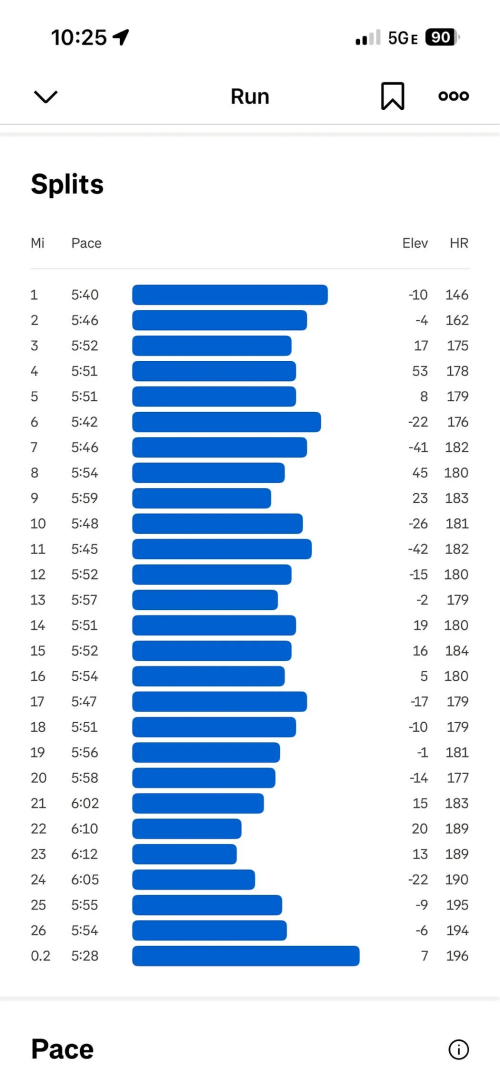
Screenshot from the author on Strava
Now, I can accept that I, like most people, am bad at predicting the future. Having a long-term mindset where I continue to maximize my odds is still important — I want to maintain the illusion of at least being able to control some things. I can control my effort, routines, and preparation, and all parts of the process, but the outcomes belong to the world and are subject to a high degree of variance.
The best example is sleep. I aim to be in bed at a certain time every night. What time I actually go to sleep can depend quite a bit. I have a routine that includes reading a book, but I can go to sleep five minutes after going to bed, or it can take two hours on a day I was particularly nervous (like the night before taking the bar exam).
This ties into a broader mental and emotional approach to embrace uncertainty. The randomness of the future is a sign to never get too confident and certain. I believe in jinxing the future by being too confident. It’s not rational and it’s highly superstitious, but there probably is value in that belief — that there is peril in arrogance and hubris, that no matter how confident I am, there should always be a lot of humility.
I find this moderating embrace of the unknown refreshing because it also lets me catastrophize and think about worst case scenarios less. Yes, they sometimes happen, and I should occasionally mentally prepare for them, but, like I can’t predict the best case scenario all the time, I also cannot always predict the worst.
People are bad at predicting the future. I’m one of those people. I don’t think I will ever stop predicting, but now I know the future is a humbling world of unknowns, where I will be wrong quite a bit.
—
This post was previously published on Ryan Fan’s blog.
***
You may also like these posts on The Good Men Project:
 White Fragility: Talking to White People About Racism |
 Escape the “Act Like a Man” Box |
 |
 |

If you believe in the work we are doing here at The Good Men Project, please join us as a Premium Member today.
All Premium Members get to view The Good Men Project with NO ADS.
Need more info? A complete list of benefits is here.
Photo credit: iStock

