



My best friend Ally sits on the bed next to me, holding her stomach. We’re in 8th grade and on a class trip to some mountain-y town, the name of which I forgot. And right now, it’s time to go to the “disco” in the community room, where we’ll listen to Cotton Eye Joe forty three thousand times. But Ally is crying, because she’s in so much pain. I don’t know what to do so I tell our PE teacher who is one of the chaperones. She’s tall and tan and blond and more athletic in her mid forties than I’ll ever be in my entire life. She sits down on the other side of Ally.
I say “Just think of something else.”
“That’s not going to help,” my teacher says calmly. I’m annoyed. Of course, that’s what you do. You ignore the pain. You distract yourself.
The teacher looks at Ally: “If you’re in real pain, there is no point pretending you’re not. You can try to focus on your breath to calm yourself, but trying to ignore it isn’t going to help.” It is the dumbest thing I ever heard. But Ally stops mid-sob. The teacher sits with her, helping her to breathe and telling her she is sorry that it hurts so much. About 45 minutes in, the cramps finally ease.
More than two decades later, I have an eighth grader who is groggily coming out of surgery as I peak around dividing curtains searching for her pale face with the long dark hair and lashes. The nurse told us she was doing just fine, but within minutes she starts crying and screaming in pain, whipping her head back and forth. I try to hold her and reassure her, but it’s hard to even get close. The bed has rails and I’m worried about kinking one of the many tubes snaking around her body measuring everything that can be measured. I want to tell her that she’s fine, that everything will be fine. Only the last one of these is true. I think.
Watching my baby’s face contort in pain makes me feel helpless. I don’t feel helpless. I am helpless. So I hold on to her and tell her that she will get through it and that I’m here and that I’ve got her and that the pain meds will work and soon the pain will be more bearable. But secretly I want to murder everyone around me. The doctor who did the surgery, the anesthesiologist who promised she wouldn’t wake up in pain, the nurses who are just walking by like this is normal. They’re not giving her the meds fast enough and the only reason I’m not screaming at them is that I keep promising my daughter that I will stay right where I am and she’s crushing my hand so desperately that I barely look up at anyone else. I try to be like my PE teacher. I try to tell her to breathe and focus on the in and out of her lungs. She doesn’t even hear me. She barely looks at me. Her eyes are open but she’s in a different world I can’t enter. I feel like a failure. I can’t take the pain away and I can’t even comfort her. And there are several moments where the best I can do is not start crying myself which makes me feel pathetic.
Our nurse Annie administers the medicine, then takes my daughter’s face in both her hands. She tells her to slow everything down and breathe. She is completely in charge of the situation. She tells my daughter quietly in very few words how slowing her breathing will calm her entire body. Shockingly, this works. My daughter starts breathing more slowly between sobs. I’m relieved and ashamed at the same time. Nurse Annie hugs me and I choke out a thank you. I say, “how did you do this? I couldn’t even get her to look at me, or listen to anything I said.” I feel like a bad mom. Nurse Annie hugs me tighter and whispers back: “I have six kids and none of them would calm down if I told them to. Parents are where kids fall apart, nurses are where kids pull it together. This is normal. This is what I’m here for. You’re doing great.” And even though I still feel ridiculous and pathetic that I need reassurance when it’s my little girl who just got out of surgery, I’m grateful for the kindness.
Days later, I ask my daughter her pain level, as I have about a gazillion times since we got home. Her pain is moderate to severe still but she is no longer crying in pain and panic every time a wave rolls over her. I ask her why. She tells me that even thought the pain is roughly the same, there are a few things she’s learned.
Pain can mean healing. This isn’t true all the time of course, but the doc said that some specific pains, like certain burning and itching sensations actually mean the wound is healing. Just knowing that some of the discomfort is caused by a good thing is enough to make the pain more tolerable.
You can exist with the pain. She said the pain is still there, but she is no longer focusing all her energy on it. She is purposely using the things that help her. In the hospital, I asked her if she wanted her phone to listen to her music, knowing that has always been a comfort. Soon she was laying there, getting through the waves by mouthing the words to Hamilton and Percy Jackson. If it gets really bad, she focuses on rhythmic breath, using the out-breath to vocalize or cry, but sticking with her rhythm instead of letting the pain dictate the rhythm of her breathing.
The pain won’t last forever. Unless it’s a chronic situation, most pain doesn’t stay the same over long periods of time. It comes and goes, changing in intensity. After days of enduring waves of pain, the focus has shifted from dreading the next wave to the knowledge that she can and will get through them every time. She went from saying I can’t do this, I can’t do this, to knowing she can. That does not come from anyone telling her, but her experiencing that she can take the wave and let it roll, knowing she will come up for air again.
At 13 years, she knows much more about pain than I did at that age.
And still, she asks me to stay and I squeeze into her twin bed next to her with half my ass hanging off the mattress and my neck kinked against the wall. Her sweaty head is resting against my chest and I try to slow my heart to sound reassuring, while I stroke her hair. Both her hands are holding on to me, my arms, my belly, her breath slowly getting deeper. And when I detangle our limbs and tiptoe through the night, the house dark, to find another ice pack, or another pain pill, or another pillow, I remind myself that this is sacred ground I’m walking on. I have no religion and no faith, but these tiny moments in the early morning hours, when we’re the only two awake and she still needs me, are fleeting and almost holy.
The next day, after not eating much for a few days, she requests Taco Bell and all her siblings crowd into the room, sitting on the floor with smelly feet and dripping salsa everywhere. The entire room smells like tacos and farts, garbage strewn everywhere. But she’s laughing. Coming out of the drug induced haze. Back to cracking jokes and bickering. And that night we go back to “can you close the door behind you, mom? I’m watching my show.”
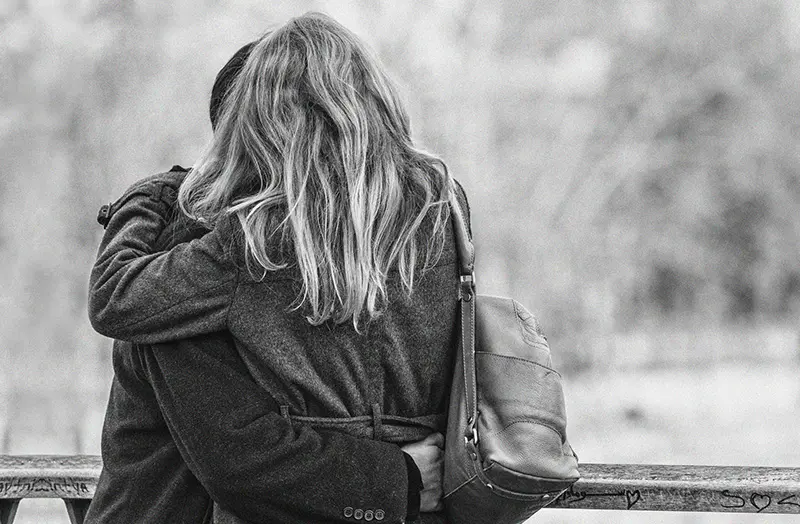
Things are the same and things are different. We both know more about each other or were maybe reminded of what we already knew. I know that she is capable of figuring out how to handle things her own way. Even really hard things. And she knows I won’t be able to take her pain away, but I will be right there with her.
—
This post was previously published on Medium.
***
You Might Also Like These From The Good Men Project
 |
 |
 |
 |
Join The Good Men Project as a Premium Member today.
All Premium Members get to view The Good Men Project with NO ADS.
A $50 annual membership gives you an all access pass. You can be a part of every call, group, class and community.
A $25 annual membership gives you access to one class, one Social Interest group and our online communities.
A $12 annual membership gives you access to our Friday calls with the publisher, our online community.
Register New Account
Need more info? A complete list of benefits is here.
—
Photo credit: markzfilter / Pixabay

