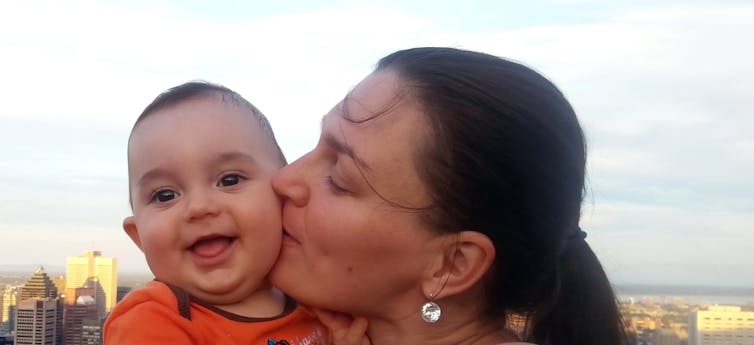
At McGill University’s Infant Speech Perception Lab, we have been studying how babies begin to take their first steps in acquiring their native language or languages.
First language steps
Long before babies can say their first words, they’re already taking many steps to learn about their language. Our research has studied one of these challenging first steps — the ability to track when one word begins and ends in speech, or what are heard as word forms.
Before babies begin speaking words, there are many steps involved. (Shutterstock)
It’s challenging to track these word forms in speech as people rarely pause between words when they speak. As adults, we can locate word boundaries in our native language effortlessly. However, we often fail altogether when we encounter an unfamiliar language.
Words are formed differently in different languages. Let’s consider English and French, Canada’s official languages.
English is a stress-timed language, which means that each syllable within a word is spoken with different stress or emphasis. For example, say a two-syllable word in English out loud. Chances are you produced the first syllable with more stress — that is, longer, louder and with a higher pitch. Most two-syllable words in English follow this pattern (for example, BA-by, HAP-py, BOT-tle).
This is because French is a syllable-timed language, where each syllable within a word has nearly equal stress. Syllables are given more stress only when they fall at the end of a phrase or a sentence (for example, donne-moi un ca-DEAU).
Nevertheless, since stress does not provide a consistent rule for distinguishing words in French speech, French listeners have to rely on other rules to find words in conversation.
But, it seems that babies learning both English and French have to contend with conflicting rules. If they were to focus on stress cues, would a stressed syllable represent the beginning of the word, as it frequently happens in English? Or would it mean the end of the phrase or sentence, as in most cases in French?
Don’t like ads? Become a supporter and enjoy The Good Men Project ad free
To navigate this challenge, bilingual babies need to keep track of whether they are hearing English or French. But, is this too difficult or confusing for bilingual babies?
We tested bilingual babies in a task that assessed how they recognize word forms, and we compared them to their monolingual peers. The experiment involved 84 babies, ranging from eight- to ten-months old. We tested babies learning only French, babies learning only English and bilingual babies learning both languages.
This is an impressive feat given that bilingual babies have to learn two different language systems in the same time period that monolinguals learn their single language. It is certainly a learning progression, but even young children can tell when they are hearing two languages.
We are proud of our SOCIAL INTEREST GROUPS—WEEKLY PHONE CALLS to discuss, gain insights, build communities— and help solve some of the most difficult challenges the world has today. Calls are for Members Only (although you can join the first call for free). Not yet a member of The Good Men Project? Join below!
All levels get to view The Good Men Project site AD-FREE.
Register New Account
Please note: If you are already a writer/contributor at The Good Men Project, log in here before registering. (Request a new password if needed).
◊♦◊
ANNUAL PLATINUM membership ($50 per year) includes:
1. AN ALL ACCESS PASS — Join ANY and ALL of our weekly calls, Social Interest Groups, classes, workshops, and private Facebook groups. We have at least one group phone call or online class every day of the week.
2. See the website with no ads when logged in!
3. MEMBER commenting badge.
*** ANNUAL GOLD membership ($25 per year) includes all the benefits above — but only ONE Weekly Social Interest Group and ONE class.
*** ANNUAL BRONZE membership ($12 per year) is great if you are not ready to join the full conversation but want to support our mission anyway. You’ll still get a BRONZE commenting badge, and you can pop into any of our weekly Friday Calls with the Publisher when you have time. This is for people who believe—like we do—that this conversation about men and changing roles and goodness in the 21st century is one of the most important conversations you can have today.
♦◊♦
We have pioneered the largest worldwide conversation about what it means to be a good man in the 21st century. Your support of our work is inspiring and invaluable.
—
The Conversation is an independent news and commentary website produced by academics and journalists, free for the public. Follow on Twitter @CA_conversation