


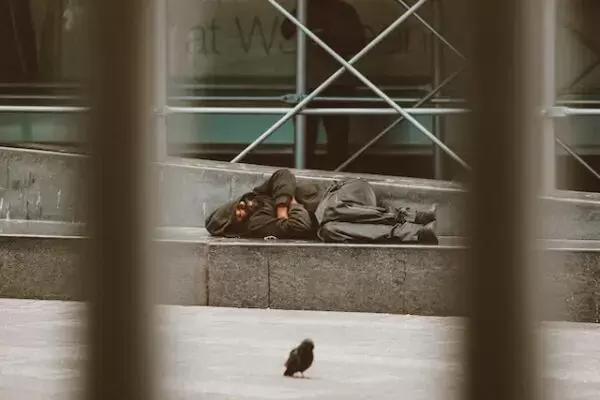
In a recent interview on homelessness with NY Mag, former LA Times reporter and author, Sam Quinones, discussing meth and fentanyl said, “Both of them are intensely addictive, and both of them do a masterful job of what every drug of abuse has always done, and that is to hijack our instinct for self-preservation. These two drugs come in such enormous quantities and have such staggering potency that they do the job far more masterfully than drugs have done it before.
So you have methamphetamine that is driving people to homelessness, and becoming incoherent and irrational and delusional and paranoid. Fentanyl is highly, highly addictive, and it’s basically ridding our country of heroin. There’s very little heroin on the streets of America anymore, which is an amazing thing to say. Fentanyl has essentially outcompeted it.
Both of those drugs, together and alone, make it so that people will literally refuse treatment, will literally refuse housing even when they’re living in tent encampments, even when they’re living in feces, in lethal temperatures, beaten, pimped out, because they do such a masterful job in potency and in supply of keeping, of thwarting that instinct to self-preservation.”
The quote provides an important distinction between the lived experience [homelessness] and the conscious experience. What the reality is, or seems to be for many is not what the brain [under influence] gives, making the brain a factor in what drives demand probabilities for homelessness.
If the brain is a key factor, then the brain—for how it gives experiences—is a factor for solution. The situation of homelessness and substance abuse across cities has economic, social and political angles in policy considerations—necessary to fix aspects of the problems. These fixes, however, are unlikely to change much for the local chapter of a national or international aberration, if the brain is excluded.
Whatever drives people to homelessness, then to stay on or for progression to worse for some, has a lot to do with the unknowns of the mind—which also makes substance use fester in a community.
Homelessness is a [lived] reality that drives experience, so is substance use and its effects. Experiences are given by the brain. How the brain decides experiences is a tool that can be applied to fight homelessness directly from the mind that permits its normality or extent.
If an unhoused person can see how the brain makes determination for all experiences in that state, there is a chance to realize how to pivot from harm, or lean towards a way out, or to revisit what went wrong and decide for a better tomorrow.
Substances disconnect many users from obtained reality, letting the brain give something else instead, which is then used to relate with the world. That disconnection, or self-preservation mechanism holds promise against the growing problem of homelessness.
The rules or pathways of experiences in the brain apply in fighting homelessness and substance abuse in a direct and affordable way, as a carry-on of moment-to-moment of what the mind does, as a lever against the automatic pulls into the void.
The brain is composed of cells, blood vessels, tissues, signals, molecules and so forth, but the experience of individuals is none of those. No one experiences a cell, neither is the experience a molecule, including the world-famous dopamine.
What cells and molecules build are experiences, but the cells and molecules are not experienced. Pleasure, high or delight may be experienced, but not dopamine. The blocks or construction materials of a building are not [normally] experienced—but the inhabited building is the experience.
Neuroimaging does not see experiences. It displays activities in regions of the brain, which may correspond closely to an experience, but it is not the experience that is displayed. Though molecular targets have been useful to develop psychiatric medications, they help change some experiences from symptoms and deliver other experiences [or side-effects].
This says that molecules are involved in general builds, even when they seem to have outsize influence in one area. Whatever is done to increase or decrease a molecule by a medication, has affect for other builds or experiences.
Experiences—used in interactions with the world—is the key to figuring out what, why, where, how and which, for decisions in the brain with major consequences of mental health for many.
Conceptually, the brain has locations of properties, which can be acquired by quantities to give experiences. This means that there are quantities that relay in the brain to destinations, where they acquire properties that decide what gets experienced, to degrees, matching with the external or not. Cells and molecules of the brain as a lower stage build or construct the upper stage of quantities and properties for experiential interactions with the world.
Quantities and properties are builds, which can be used for added build—like a place where retrofitting is made. This says that the lived reality of homelessness for the experience in the brain can build layers against self-preservation, even for something that seems so obvious.
Properties in the brain include: fear, trauma, loneliness, helplessness, melancholia, paranoia, irritation, pain, frustration, anger, delight, hesitancy, despair, sleep, thirst, lethargy, liveliness, hate, love, interest, like, stress, disinclination, sleepiness, wakefulness, curiosity, extremism, and so forth.
All memory, feelings, emotions, and reactions are properties in the brain, where quantities relay to acquire. There are splits, sequences, principal spot, prioritization and pre-prioritization that determine how and to what degree experiences are shaped—as the basis of how the brain works consciousness, conceptually.
Mental health—or problems—is not a result of social, economic or political situations, rather, by the destination of quantities in property locations in the brain. Some have it good, yet have mental health problems. Some don’t, yet don’t have the problems. It is not the case for everyone, in the same situation at the same time, or for the same person, in a similar situation, at different times.
Screen time affects sleep because it becomes a property that acquires wakefulness, beating the sleepiness built by the molecules [melatonin and adenosine] of sleep, at times. Sound too, may sometimes affect sleep, because it prevents the acquisition of the calm property that precedes acquiring sleep, conceptually.
The symptoms of mental illness, disregard for safety resulting from prolonged drug abuse are all properties in the brain, acquired by quantities, some prioritized, others pre-prioritized.
The unhoused person is in lived and conscious experiences often, messing with the mind, most times. The opacity, however, of the mind makes it difficult to know how to fight, sometimes, without resignation to despair, substance use for spikes in mood [a property], or to cope against the automatic property acquisition of depression, panic, shame and so on.
Making this available as a display for unhoused people to see and understand the mind for experiences, would become a powerful, target architecture in working against the supply side of homelessness, precipitation into serious mental illness and substance abuse, for some.
This could become a new display, where they are shown the mind in places they get some help or care, as well as on their devices, to be alert to determinations of quantities relay, including their sequences and prioritization or pre-prioritization, to know when that thing has gone there again that often precedes what gets them into some trouble, and so forth.
—

