



Insanity, I’ve been told, is doing the same thing over and over again and expecting different results. After each disappointment, I try to bounce back and expect this next time to be the breakthrough. It might seem delusional, but I refuse to give up on hope.
I am talking about my time as a runner, as I have largely been doing the same thing in terms of training for the last two years, only to be the same, if not worse. I have run personal bests in races like the half marathon and a 20-mile race, so I don’t want to frame it like it’s all bad. However, I have not run a personal best in the marathon, which is the main race I have trained for.
Every January and July, I try to run 300 miles. I do it because it’s part of a mileage challenge I do through a local run club, where I help my friend’s charity that raises money for Type I diabetes research. Also, it makes sense logistically as an athlete who trains for marathons. In a 30-day month, 300 miles means averaging 10 miles a day, 70 miles a week, which gets me in shape pretty fast.
The last week of July, I ran 90 miles. I ran more than 10 miles more than five days of the week, with one 20 mile week. Hitting 300 miles is one step in the process of becoming a faster runner.
Numbers and stats aside, running that much in a week requires some major lifestyle challenges and planning most of my day around running. I am not a fan of “doubling,” which is running twice a day. It’s usually hard to plan for me to plan meals and shower and do other parts of the running routine, so I prefer to run 12–16 miles rather than do a six mile run in the morning then an eight mile run in the evening for lifestyle reasons. As a special education teacher during the day and law student at time, finding time to exercise when I barely have time to exercise has been difficult, but manageable.
However, running 12–16 miles in the morning is a major energy expenditure that leaves me operating at 60–70% maximum cognitive capacity the rest of the day. I can still power through the day, work hard, and be productive, but I would be lying if it isn’t very difficult to do so. In fact, on days I have exams for law school, I skip my run and have a major boost in acuity and sharpness. If I can find time, I usually try to take a midday nap to recover some of that sharpness I lose.
This is all to say that a hobby as consuming as long distance running requires some significant sacrifices. I wonder how much I could accomplish in other areas of my life if I didn’t run. I wonder what avenues or parts of myself I would discover with the void that quitting running would bring. I have been through hiatuses where I found new groups to hang out with or got involved or more enmeshed in other areas of my life, but ultimately, for the past 15 years, I have returned to running in some capacity, whether casually or competitively.
Right now, the challenge I put for myself now isn’t running 300 miles just two months of the year, but every month. I average 10 miles a day during these 300 mile months. But it isn’t that simple. On some days, I run four miles or less. I just feel like trash or need the day to recover. On other days, I don’t run at all. However, that does mean that there are medium long runs where I run 14–16 miles. It does mean there are very long runs where I run 20–24 miles. To the average person, it doesn’t make sense, but these are sometimes just the highs and lows of being a runner.
Running isn’t about huge feats of hard work and hard training. I used to think that’s what it was about. But in truth, it’s about consistent training at a relatively moderate intensity. Some runs and workouts are hard. But most are supposed to be easy and moderate. It’s tough because you can’t always wait for inspiration and motivation to strike. It takes lots of runs where you don’t feel like running at all.
I think about the times when I was in the best shape of my life. This included just before my senior year of college, and a couple of times in the past couple of years. I cannot recall a single workout I did that was “crazy,” but that I just ran often and consistently enough to get more fit as time went along. It required a ton of easy running and running pretty slow, much like legendary marathoner Eliud Kipchoge does.
I’m mostly just training aimlessly without a race goal. I have spent summer watching the Olympics, with a particular focus on track and field. I have seen the world get really, really good at distance running. Olympic records have been broken time and time again in the distance events, whether it is in the men’s 10000 meters, men’s 1500 meters, and women’s 3000 meter steeplechase.
The narrative is often that new “supershoes” are leading to these records. However, it is rarely a new face bursting to the top of the scene that has broken these records. It is the same people who have been at the top for a long time. These athletes may have some sort of breakthrough, but it’s their consistently in not getting injured and training hard for a very long period of time that really gets them to the top. For casual recreational runners like myself, getting carbon-plated supershoes certainly helps, but it’s training
I try not to focus too much on the outcome. But I do aim to be consistent. I aim to just have fun running and follow the process a lot more than I focus on the results, but I won’t lie and say that I don’t want to get faster and break barriers, either. It’s a lot of internal conflict over wanting the process to be fun and the results to come, but running a personal best, for me, has historically meant a lot more than just running a personal best. It feels like a limit on myself that was previously broken and a personal breakthrough. A new personal best is a high that feels like no other.
I am going to rely on many changes to my approach to get better as a runner as we transition from summer to fall. I should preface that this is only what I’m trying to do and experiment with, backed by trusted advice of runners and coaches I respect. Different things work for different people, so please don’t take the shifts I am taking to take the next step as a runner as gospel.
The fall boost
Summers are a notoriously difficult time for me to run due to the heat and humidity. You don’t appreciate how great running in average, somewhat cool conditions feels until you run in 100 degrees Fahrenheit and 90% humidity. These are runs where you feel like you’re going to die the whole time because of the hot and humid conditions of summer.
I spent four years of my life in Atlanta during college, and I now live in Baltimore, which is not as humid as Atlanta. When I was in Atlanta, it was absolutely unbearable to run any time after 8 a.m. in the summer, given average daily highs of 86 degrees Fahrenheit and that Atlanta is a very humid place. This meant my cross country teammates and I always had to wake up at 5 a.m. to run.
Running in the heat and humidity is difficult to a lot of people, but perhaps I am just particularly sensitive. I have to slow down a lot or cut my run short on very hot days. However, I do know some people who have no decline in how they feel or their performance on 95 degree days.
I say all this to say that when the temperatures drop and humidity declines, I get a “fall boost.” Suddenly, paces that were unbearable for me to hit over the summer become incredibly easy. Suddenly, on a good year, I’m hitting personal bests left and right. There are still hot and humid days where I have to recalibrate my expectations and adapt, but I run faster and running feels a lot better through no reason other than cooler and less humid weather.
This means that during summer training, since I’m not one of those people who seems to be completely immune to the heat, I have to remind myself that feeling like I’m going to die every other run and running really slow will feel really discouraging. I ran two 10ks over the summer in conditions that were around 75 degrees Fahrenheit and 90% humidity, and I ran around 37:30 going all out in both races. This is 6 minute mile pace, which isn’t necessarily bad, but is very slow for me and over four minutes off my personal best.
I had to calibrate and shift my expectations: these were good races for these conditions in the summer. Additionally, they were very hilly courses. Three weeks later after my second 37:30 10k, I ran a 12 miler in 67:42 on a day that was only slightly less humid and 10 degrees cooler than the summer 10ks, which corresponds to 5:38 mile pace. I felt significantly better on this day and way better than I felt on either 10k, and I find it funny that I ran over 20 seconds per mile faster for twice the distance.
What did I do different in those three weeks? Nothing. I did not change, but the effects of fitness from my training of 60 to 90 week miles may have been cashed in. However, the weather changed, and made all the difference. Plus, I have adapted more to hot and humid conditions.
I am racing one fall marathon this year, and it’s in the middle of November, where the weather will hopefully be ideal (in the 40s or 50s and minimal wind and humidity). I occasionally look back to grueling days of the summer where four mile runs in the middle of the day were excruciatingly hard, and remember how lucky I am that it’s no longer summer.
One workout a week
A big mistake I used to make was overdoing the intensity of my training for the marathon. For most of my marathon training, I was running two workouts a week, plus a long run. This may be fine for a half marathon or if I was training for 10ks.
But I didn’t realize the toll that was doing on my recovery for the marathon, so I received some other training plan and although I am not following it super religiously, I am making some adjustments to my training plan to not include that second workout. For more marathon related training, the long run may include a few miles of pickups at marathon pace, so the “second workout” is incorporated a bit with the long run. It’s more important to get in more easy miles to build my aerobic base.
Say I do workouts of 6–7 mile repeats with one minute rest. I used to do that twice a week, on Tuesday and Friday or Wednesday and Saturday. I would then do a long run on Sunday that could be 20 miles or more. I now would only do that workout once a week and instead put in two 20 minute pickups in the middle of my 20 mile long run.
Fueling and nutrition
Every marathon, I usually only take two or three gels all 26.2 miles. Gels are packets of some liquid-solid hybrid with carbohydrates and sugar that help you recover during runs. Some have caffeine, and some don’t.
During long runs of 20 miles or more, I used to only eat one or two gels. I do this because carrying more than two in my hands is a bit of a hassle and I feel like it would slow me down. I also worry about consuming too much during the marathon because it might upset my stomach and I might need to stop to use the bathroom in the middle of a marathon. Plus, it doesn’t help that gels are pretty expensive and average $2 per gel.
I realize consuming 100 calories twice in an almost three hour race is likely not enough. A former coach said I should fuel at least once every eight 45 minutes on an effort that is 10 miles or above. Every runner is different, but she has gained this insight through running 50 milers and trail ultramarathons.
In terms of fueling, however, I realize it is better to be safe than sorry. Having to use the bathroom during a long race is much better than muscle breakdown and not having enough nutrition during the run. Part of my nutrition effort is also making sure I am eating enough during the day — I realize I need more fuel than most people, and due to my busy schedule, I am in a rush and may not take enough time to get enough caloric intake.
Running (almost) every day
“Should I run every day?” is a somewhat divisive topic in the running community.
Most coaches don’t recommend running every day for beginners, according to Jenessa Connor at Running Warehouse. Nike recommends at least one day a week of rest to allow muscle recovery. I know people who can take a week or even more off and still feel fresh and perform well.
However, for me, the problem is how my body feels when I take too even two days off. I feel rusty. My muscles ache because they’re not accustomed to running anymore. One mistake I make in the weeks prior to a big marathon, where it’s customary to run fewer miles than usual to recover and feel fresh for the race, is taking three days off at a time.
To me, running two miles on a day I’m tired and don’t feel like running is a lot better than not running. I don’t always run every day. I take days off when there is a lot going on. However, I won’t take more than two days off, as that is when the lack of consistency and routine catches up with my body. Perhaps this is me being a stickler for routine, which is mental, and perhaps there is a physiological benefit to running almost every day.
Letting my hair down
The past two years, I have been growing out my hair. I saw Asian actor Daniel Henney able to pull off a cool look with long hair and facial hair in The Wheel of Time and decided on a whim that I wanted to replicate that. Since then, my hair has grown from short hair to long hair that goes to my upper back. I have also grown a beard, but that is another story (to the dismay of my family)
Sometimes, the hair is very inconvenient. While running, I have tied it up because I thought it was ideal not to have long hair bouncing around during a run. But the other day, during my 12 mile race, I let my hair down.
Not only do I have long hair, but I have straight long hair, which means that my hair gets incredibly tangled if I run a long time and tie it. Logistically, letting my hair down while running lets me not run into the inconvenience of taking 20 to 30 minutes to brush it.
With my hair down, I felt a lot more free and unrestrained. I felt like I could run a lot faster. I realize a lot of that could be in my head, but that kind of confidence matters to someone like me, who is plagued with self-doubt.
. . .
These are just things that work for me as a runner. They come from a desire to experiment, to enjoy the process, but also from knowing what has and hasn’t worked for me over the past 15 years as a runner. If I had the silver bullet that was the key and secret to getting better, I would have seized on it a long time ago. But I never have, and it’s always just a combination of everything. Some things work, and some don’t, and you don’t know that through anything but trial and error.
Some big shifts over the years have included running slower and not going so hard all the time, not making huge surges during my races and keeping my effort consistent, and long-term consistent training without getting sick and injured. There is no sexy answer — sometimes, boring is just better.
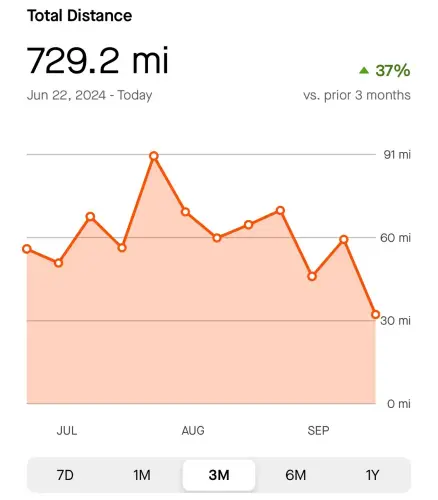
Screenshot from the author on Strava
The past three months, I have run 729 miles, which is an average of a little over eight miles a day and 60.75 miles a week, which is the longest stretch of consistent, high mileage I’ve had over a three month span. One key is not seeing the success of my mileage in terms of what I ran in a week, but having a more long-term perspective of what I was able to do over a month, or three months. That has been very helpful if I have tunnel vision and get overly discouraged over one bad workout or one run where I felt terrible.
I don’t know how many times I have told myself “it will be different this time” only for that not to be the case. My life circumstances make it hard to run as much as I have been running. But I do know the big key to the times I have taken big jumps and improvement in my running, particularly in longer distance races, is high, consistent mileage, coupled with sufficient recovery and nutrition.
The past two years, for example, I had weeks where I could run 60 to 70 miles, but they were preceded or succeeded by weeks where I only ran 30 to 40 miles. This inconsistency likely did not help, but it was a byproduct of needing to make running a low priority compared to my job of being a special education teacher and law school.
This time, I am not just doing the same thing and expecting different results. This time, I hope it will be different.
—
This post was previously published on Ryan Fan’s blog.
***
You Might Also Like These From The Good Men Project
 |
 |
 |
 |
Join The Good Men Project as a Premium Member today.
All Premium Members get to view The Good Men Project with NO ADS.
A $50 annual membership gives you an all access pass. You can be a part of every call, group, class and community.
A $25 annual membership gives you access to one class, one Social Interest group and our online communities.
A $12 annual membership gives you access to our Friday calls with the publisher, our online community.
Register New Account
Need more info? A complete list of benefits is here.
—
Photo credit: iStock

