



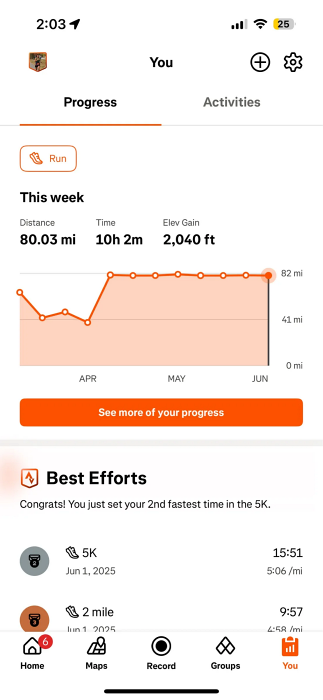
I have run 80 miles a week for the past eight weeks, all of which while being a special education teacher and recently becoming a lawyer. This has been my big process goal for my marathon running — I want to run 80 miles every week for half a year, hopefully through the summer, to get better as a marathoner.
But I did not get here overnight. I have been a long-distance runner for the last 16 years now. I have long just followed the process and blindly followed what my coaches said to do in high school and college, but now, I have had to find my own way as an independent runner.
When I started training on my own as an adult several years ago, I would run when I felt like it. I would treat running as a hobby, and took a step back from running as I attended more to my job and personal life.
But I still wanted to run well and run fast. I did run fast in some events, but these were sometimes far and in between. I would execute well on given days, and there were days where the conditions allowed for running fast, but in hindsight, I would not be consistent. There were weeks I would run 30 miles a week, and there were weeks I would run 70 miles a week. There would be some weeks when I would barely run at all. Given inconsistencies in my schedule and routine, there was a resulting inconsistency in my running performances.
Thus, since I no longer had a coach guiding me at this point in my running, I realized I did need to have a more focused approach. Running a lot of miles, at times 65 to 70 miles in college, kind of just happened. I went to practice and ran. I ran with my friends. I did workouts with my friends. I raced with my friends, did Sunday long runs with my friends that could stretch anywhere from 11 to 17 miles. It all just happened because, for several years, these scheduled runs and practices were baked into my routine.
As an adult, it became a lot more difficult, but I realized my problem. I was not consistent. I also expected results right away from any sudden increases in the intensity of my training or any big weeks, when in reality, it sometimes took several weeks or months to see benefits. I realize it can even take years, so realizing things take time was a gradual revelation. Long-term, I had to run a lot of miles, consistently, over a long period of time.
Last fall, I went through a cycle where I ran 60 miles a week and averaged that mileage for around six months. A lot of those miles were during the grueling summer, when I felt like I was going to die each run, but they paid off long-term. I ended up running a 2:35 marathon and ran a personal best by over four minutes.
I thought I was at a limit and plateau since I hadn’t gotten better in the three years past in the marathon, when all I really needed to do was train better and more consistently. Honestly, this was a period of time when I doubted whether I could get better at all.
I learned a lot about myself as a runner: I am someone who gets better the more I run, but I need to be able to maintain the routine and do this consistently. I tried 70 miles a week from the winter into the early spring, which got me into better shape, but I got unlucky with some races where the conditions were challenging. That period of time did make me more fit now and able to handle 80 miles a week.
There is a point where there are diminishing returns, so I need to proceed cautiously and be responsive to how my body feels. I have not averaged 80 miles a week over a long period of time before, so I’m trying it now. I don’t know whether I will ever be the person with the time and ability to fit in 100 miles, as fitting in 80 miles a week has been a challenge. Here’s how I’ve done it.
I first want to caution, however, that running 80 miles a week consistently did not happen overnight. I built up to it very gradually over these past few training cycles, and it took my whole career of running to be able to train my body to handle it.
I probably wouldn’t have benefited from running this much in high school or the early parts of college, and there is a very good chance my body would have broken down if I tried to do this much mileage this consistently in those parts of my running career. Thus, I would not recommend this much mileage to any new runner or high school runner. In fact, if I were a coach (which friends have asked and I have consistently declined), I would not start any runner for more than 10–15 miles a week in their first month of running at all. But this was the best path forward for me.
Scheduling
To be able to run 80 miles a week, I realized that everyone has a different schedule. When I first started running 80 miles a week, my schedule from Monday through Thursday would be very busy from 7 a.m. to 9 p.m. since I went to law school at night after work. In fact, I would have to squeeze in the runs either very early in the mornings or late at night.
It was not easy, and I had to know that although I could do my best to run on those days, my weeks would involve backloading a lot of mileage. This sometimes meant I had only run 40 miles from Monday to Friday, only to put in a behemoth effort over the weekend of a 16-mile run followed by a 24-mile run.
Again, I would not recommend this for anyone else, particularly if I were the coach, but this has been my routine for a few years and the only way I have been able to squeeze in high mileage to become a better runner, so my body was used to it.
Getting through the run
Besides the more technical side of how many miles I run on which days, I obviously also needed to actually spend the time running and get through the runs. Because of my unorthodox schedule, most of my runs were alone, which could sometimes be very mentally difficult.
I mentally break up runs into segments. The first 15 minutes of the run often feel very, very bad and sluggish. I would run anywhere from an 8:30 mile to a 10 minute mile, and I would usually spend this time listening to my daily podcast or a lecture. I would have to keep reminding myself that the first 15, and sometimes even 30 or 40 minutes, is the phase where the run just sucks. This is why my first mile is always substantially slower than the rest of the run. I would then switch what I listen to 15 minutes into something else, and just tell myself I needed to keep running “until 45 minutes in” or “until 60 minutes in” when my body would warm up and it would feel much better.
I would repeat this thought process for every run, even for the 24-mile runs that take almost three hours. If there isn’t some variety to what I listen to on these solo runs, they would mentally become even more excruciating. I often don’t listen to music, but if I’m doing a workout or faster session, I will turn on my workout playlist.
Social runs, where there is someone else to run with, go by much faster. I can just talk to the other person or the group the whole time. I realize this ends up being a great way to get to know the other person. If you run with someone for more than two hours, you talk about a lot of things — I would talk about faith, marriage, and simply very personal life ordeals because you need to fill the time somehow, and the feeling of the endorphins flowing and shared suffering builds the bonds even more.
Having deep, thoughtful conversations also helps the time go by faster. This is usually, obviously, only if we’re running a pace that is conversational for every person in the group, which means the effort has to be relatively easy. If it’s a workout or a faster session, the conversation goes out the window, but it’s still very, very motivating. Thus, as my schedule lightened up, I got into more group runs and workouts where I could rediscover the social element of running that I like so much.
Preparation
To run this much and this frequently on a busy schedule required a lot of ways to be more efficient with my time. I needed to get out of bed faster and limit the time where I build motivation to run — I needed to just get out the door and run. One thing that helped was having running clothes and socks very accessible, as well as taking caffeine early in the morning.
However, one big inconvenience of every runner is needing to use the bathroom. A run where duty calls is one that can very easily ruin your entire run. I have seen runners run very, very fast in races that have to take a minute or two off their time because they had a bathroom emergency mid-race.
Most people can imagine how the constant movement of running stimulates the bowels, and this was always a situation I dreaded too — being in the middle of nowhere with no bathrooms and desperately having to use the bathroom. This may seem like too much information, but every long-distance runner goes through this. If I got up in the morning, I would usually wait and stay occupied doing other things until my body was ready to use the bathroom.
However, this could be a very inefficient use of time, as that aspect of my body was obviously not something I could control. Thus, I started to just get out the door when I could and stay close to my house or a porta potty I knew was open and usable, and I could just stop when I needed to.
Another way I was able to fit in more miles with my schedule was by finding more routes around my house and running from home. A lot of social runs require driving somewhere. On some solo runs, like long runs, I would also drive somewhere. Cutting out the driving would save me a good 20 minutes out of my schedule — my rule of thumb is that if I need to meet someone for a run and it’s four or fewer miles away, I’ll just run there. These ways of saving time (and gas) have helped me fit in the miles whenever I can.
The training plan
My training plan is pretty simple, but it’s tailored to my own needs and strengths through trial and error. 5/7 runs of the week are easy. I might mix in a mile or two at marathon pace if I’m feeling good, but I try to keep these runs no faster than 7 7-minute mile pace. One run will be a workout. One will be a 22–24 mile long run with a workout baked into the long run — I might “progress” the long run where I try to run every mile faster, or I might put in chunks of 3–4 mile pickups at 5:40–5:45 mile pace (my goal marathon pace). If I need to, I’ll take a day off. I repeat this cycle every week.
Another part of running 80 miles every week is injury prevention and preventing burnout. Because I am running more than I ever have and I know it can take a toll on my body, I have to ensure that any run or workout I go on is not something that will completely wipe me out for the next day or the whole week. This is not to say I don’t run hard on given days during workouts, but I have to be a lot more judicious about stopping workouts, even if I feel like I could do an extra one or two intervals, or stopping runs even if I feel like I could do another mile.
It has taken a long time to get in touch with my body and the feedback it sends back, but I can sense when I’m at the point of the run where it’s actually not beneficial anymore to keep going. This feeling is hard to explain, but it’s a kind of struggle where it’s not a productive kind of pain, but just a languishing kind of pain that burns me out for the next day. If I feel extra sore, I’ll also stop the run, and if I feel extra good on a given day, I’ll extend the run a couple of miles.
To lessen the burden of any single run and from doing multiple runs of 15 or more miles per week, I have had to do something I hate: running twice a day on some days. This is called doubling. The physiological benefit of doubling is that it gives more recovery, more blood flow, and more efficient use of glycogen storage.
However, for lack of a better term, doubling is a logistical pain in the ass. It not only requires fitting in the time to run twice a day, but I would have to plan meals and snacks around running a second time of the day, do double the laundry, and shower a second time. Running already takes up a lot of time, and doubling significantly increases the amount of time running takes up in a day. I could get away with running 70 miles in only one run a day, but did acknowledge that running 80 miles a week is very difficult and likely not that beneficial to do on only single runs.
I know I can do a lot better with doubling. I double maybe once a week, but I could do two or three days of doubling once my schedule lightens up more and the school year ends. A day where I needed to run either 16 or 17 miles could be broken up into an 11-mile run in the morning and then a 6-mile run in the evening, preferably with a lot of nutrition and a nap in the middle of the day to recharge.
Recovery and stretching
I have also had to get a bit more serious about stretching to prevent injuries. As a long-distance runner, any issues I have had with cramps or muscles seizing during races have been quads, calves, and hamstrings.
Thus, I stretch calves and hamstrings especially before bed on a daily basis. I don’t do it for an especially long time or that hard, but I find it necessary to stay on the safe side. I used to get away with not stretching at all, but now that I’m running 80 miles a week, it’s a necessary precaution.
One thing I also do to stave off injury and muscular imbalances is changing directions when I am running. If I am doing an especially long session on a track or loop, I will eventually need to run in the opposite direction so I’m not turning on one side of my body. It’s something that has hurt me before that I’m a bit wary of now.
I stay hydrated and try to make sure I get in enough calories during the day. I also try to get at least seven hours of sleep a night. There are days I sleep very poorly, but I will usually need to make up for it with a nap later in the day. It’s certainly not recommended for other people because taking a long nap will lead to me sleeping poorly again and falling into a certain cycle, but it works for me. &M
Taking running less seriously
Lastly, there are ways to be better at running that don’t revolve around running. The biggest barrier for me has always been mental, since I get in my own way. I used to get anxiety over how much pain I would be in during a run, how I could blow up in the race, and disappoint everyone and fall short of my expectations. And over the course of my life, I have fallen short of my expectations — a lot.
I still get nervous sometimes, but over the course of my life, I have come to compartmentalize running as just one part of my life, and not everything. I was having bad races the last several years and not performing to my potential at all. I had to enjoy running even when I wasn’t doing well, but I also had to rely on other parts of myself and my identity outside running. I could focus on my professional career as a teacher, my role around the house as a husband, my role as a friend, or being a student in law school. I took a break from running being such a big part of my life. When I felt like it was taking up too much space, not only in my identity, I would back off a bit.
As paradoxical as it sounds, running is not as important to me as it used to be. This may sound crazy and like a lie when I’m running 80 miles a week every week and revolving a big part of my routine around it, but I mean, mentally, running is not as important to me as it used to be. 15 minutes after a run, I am no longer runner Ryan, but I tap into another part of myself — the student, teacher, husband, person who does work around the house, fan of a particular TV show, etc.
I have all these other forms of identity, happiness, and validation that I can draw on even when running does not go well, that are parts of me outside of running. That has been more important than anything else — realizing that running did not define me and shouldn’t be my primary form of happiness. Of course, when it was going well, that was great, but when it wasn’t, that was also fine.
Running 80 miles on a given week has not been that difficult — I know what it takes on any given week, and when I need to scale up my mileage for any given run, and when I need to hold back. The difficult part is running 80 miles a week is doing it every week, and being consistent doing so. The consistency has been more difficult than the intensity, but, as elite running coach Steve Magness says, it is also more beneficial as a runner to be consistent than to do super-intense work all the time.
Another difficult part is revolving the rest of my life around running with my work schedule and, right now, studying for the bar exam, but I am managing.
There is a lot of value in breaks and down weeks (weeks where you run fewer miles to recover), which any coach would recommend, but I haven’t felt the need for one yet. I will take a day off running for days I need to be mentally sharp, like for an exam or when I take the bar exam. Since I’m so used to running and the toll it can take on my energy, physically and mentally, a day off feels like it makes me a bit more mentally sharp.
It took me a while to get here, and it has taken years to build up to the point where I can build these adaptations and not get injured. Of course, I could be jinxing myself and get injured at some point next week. I hope this will not happen, but I am counting my blessings and grateful for my health and body being able to keep up. I am lucky that, despite some close calls, I have never gotten hit by a car while running, so I am trying to optimize and take advantage
I realized I just needed to take advantage of my strength of being someone who is relatively durable compared to a lot of other runners, as I tend not to get injured very often, except for one big injury I hadin my sophomore year of college. But I also wanted to focus on working out different parts of myself as a runner. On some days, I do longer, harder sessions where I try to run three-mile intervals at a 5:40-mile pace. On others, I do more speed sessions where I might try to run quarter miles around 5 5-minute mile pace. It takes a mix of strength and speed, but it’s also about having fun, so I’m hopping in more group runs, workouts, and local races.
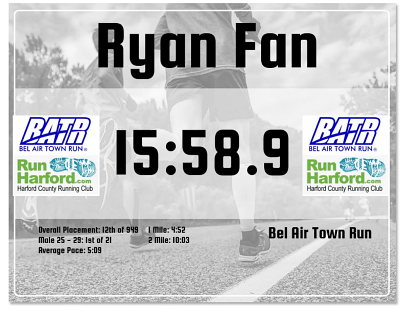
In fact, just this morning, I raced a 5k. I had done this race in two recent years and not run that fast since I wasn’t in great shape. This is a 5k with a downhill first mile and an uphill third mile, so despite running a 4:52 first mile and a 5:24 third mile, I was catching people who were slowing down through much of the race. It was the first time I had officially broken 16 minutes in the past seven years.
I write about the process of running 80 miles a week and focus on that process more than any time goals. I do have the time goal of going under 2:30 in a fall marathon. Honestly, on a track and on a day where it’s 40–50 degrees with no wind, I think I can run around a 15:20, but I acknowledge I might never get that day or opportunity this cycle.
The important part is that I am shifting away from only caring about the times I run. I want to not only focus on the process to get fast, but also the principle — if I ran hard, executed, and can honestly say I did my absolute best and gave everything I had, then it was a good day. If I also ran smart by pacing myself well, adapting to conditions, and also ran a fast time, that’s just icing on the cake.
It’s meant to be fun, and an all-or-nothing mindset where running a time I wanted means happiness and running slow means despair, then that’s not the relationship I want with running. I have been there as a runner many, many times. I do it because I’ve been doing it for a long time, and it gives me the perspective and clarity I need on the rest of life. Sometimes, it’s also fun, and I have also met my best friends through running and met new friends through running, so I am finally internalizing that it is a lot more about the process than about the time.
A good day as a runner is one where I get out the door and run. People often ask if I and other runners look forward to running every day and whether it’s easy to run every day. The answer is no — absolutely not. There are many days when I am busy, have a long day, and the last thing I want to do is get out the door and run. If I have the pressure to make a group run and meet someone or a lot of people somewhere at a given time, that makes it easier.
But day after day, despite many days I don’t feel like it, I more often than not still make it out the door, and actually get really into the run maybe 40 minutes in. I’ll end most runs feeling on top of the world and like I climbed Mount Everest, and have a brief sense of euphoria that I was able to finish the run, again, so I know I don’t look forward to running when I’m on the couch and doing other things, but I will enjoy it and feel accomplished when done.
If I coached anyone, I would encourage a mindset and goals that shift from trying to run a time to trying to follow a process. I am serious when I say success as a recreational runner, like myself, is when you try hard. Of course, running also teaches balance — you can’t try too hard, but hard enough that it’s beneficial and progressing you towards a long-term, sustainable goal.
There is so much that is unpredictable about running that makes it really hard to predictably hit times on a regular basis, like the weather on a given day, the competition that will show up, or the difficulty of the course.
The process is something that can be controlled, and that’s why, now, running 80 miles a week (with a few weeks of a break) is the most important thing for me.
—
This post was previously published on The Partnered Pen.
***
You Might Also Like These From The Good Men Project
 |
 |
 |
 |

If you believe in the work we are doing here at The Good Men Project, please join us as a Premium Member today.
All Premium Members get to view The Good Men Project with NO ADS.
Need more info? A complete list of benefits is here.
Photo credit: iStock

