


Rob Hopkins, who founded the Transition Towns movement two decades ago, has been a tireless and engaging activist for community-led Transition ever since. As the work has developed, so have the methods. What started in the Transition Handbook as a series of technical issues for towns and communities to engage with has become a series of more interesting questions on how to help people imagine the future.
His previous book, From What Is to What If, was about helping people to imagine what the Transition might feel like. His most recent book, How to Fall in Love With the Future, published in June, steps this up by addressing questions of imagination, and of how we prime the imagination for change.
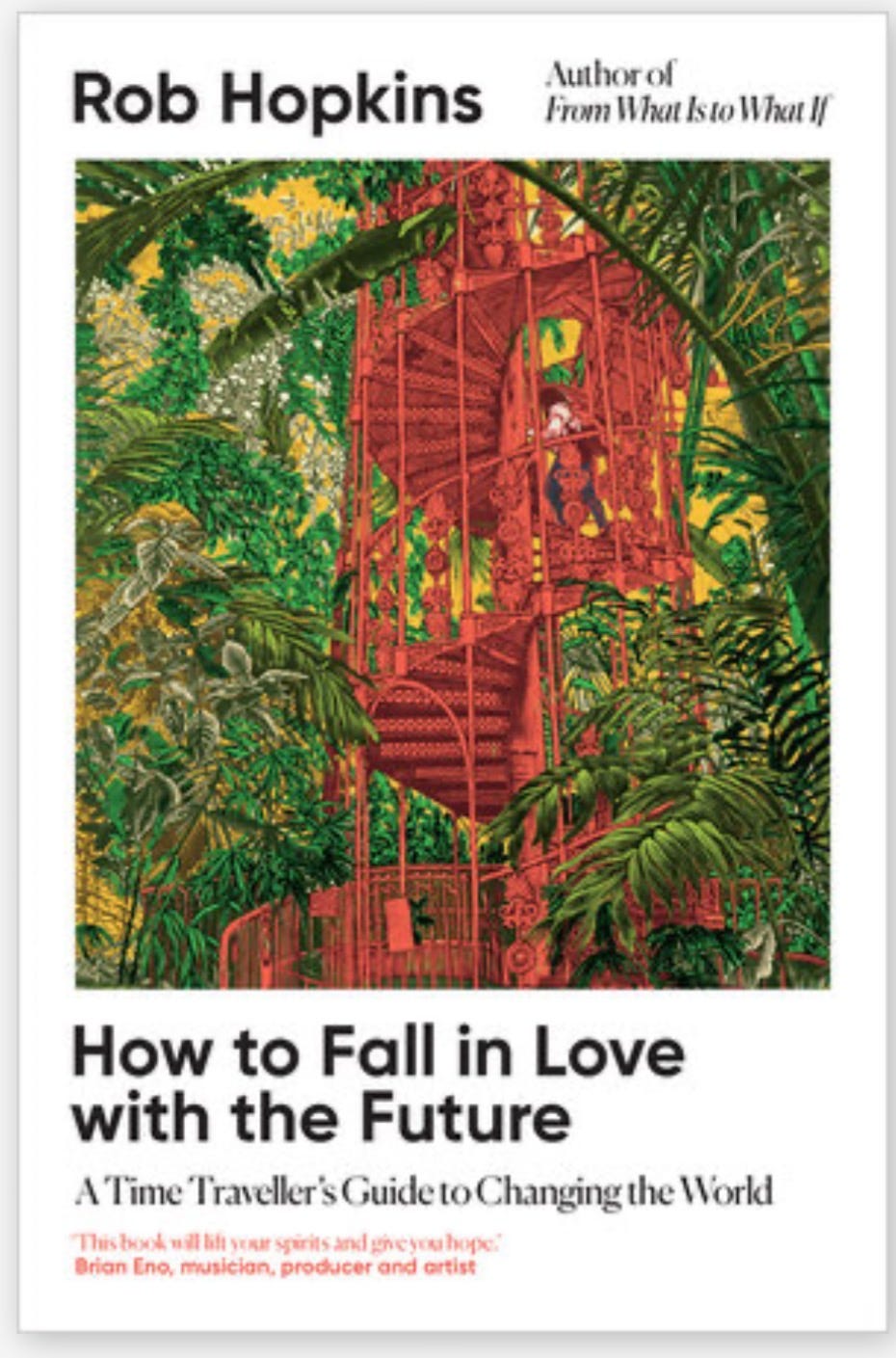
I was lucky to catch him talking last week at a webinar organised by the Root and Reason network, the community interest company that picked up the work on food resilience of the Agri-Foods Net Zero network after the AFNZ research grant came to an end. (And Root and Reason is definitely a catchier name.)
Going to the moon
Hopkins started the talk with a history of the cultural interest in going to the moon. This started just over a century before Apollo 11 landed, by his account. Jules Verne’s 1865 book, From the Earth to the Moon, was a mixture of relatively accurate technical projections (a multi-stage rocket, for example) and the horribly wrong (firing the rockets from a cannon, which would have marmelised the astronauts.) There are earlier accounts, but Verne’s was the first that attempted to tell the story in accordance with scientific principles.
From Verne you can skip through George Méliès’ early silent film, A trip to the moon, to Fritz Lang in 1929, to Mickey Mouse. When Disneyworld opened in 1955, one of the most popular attractions was ‘A rocket to the moon’. One of Tintin’s adventures took him to the moonin 1953. Everyone wants to go to the moon, in other words, and Hopkins shared a later cartoon by Hergé which has Tintin, along with Captain Haddock, Professor Calculus, and Snowy, standing in front of Tintin’s familiar red rocket to greet Neil Armstrong as he landed:
Bienvenue sur la lune, Mr. Armstrong!
The reason he’s interested in the way the idea of going to the moon resonated through culture for such a long period is because “most major achievements start with rehearsal”.
Talking about longing
And there’s a future-facing half to this as well:
What would our activities look like if we talked about longing?
His point here is that the way we talk about climate and resilience futures tend not to present that future as a particularly nice place to go to. He mentions a conversation with the researcher Peter Kalmus about what we need to do to have a fighting chance of keeping global warming below two degrees. His answer: a rapid phase out of meat production and a rapid phase out of fossil fuel use, and then we’d take it from there. This is a huge disruption to the way we live now, obviously, and feels like a set of negatives, however necessary it is.
And so in his recent work, Hopkins has created the Totnes Institute of Time Travel to visit 2036 and report from there. The Institute’s budget, fortunately, is big enough to furnish Hopkins and his co-researcher, the ambient musician Mr Kit, with the required (or perhaps precautionary) protective suits for the journey there and back.
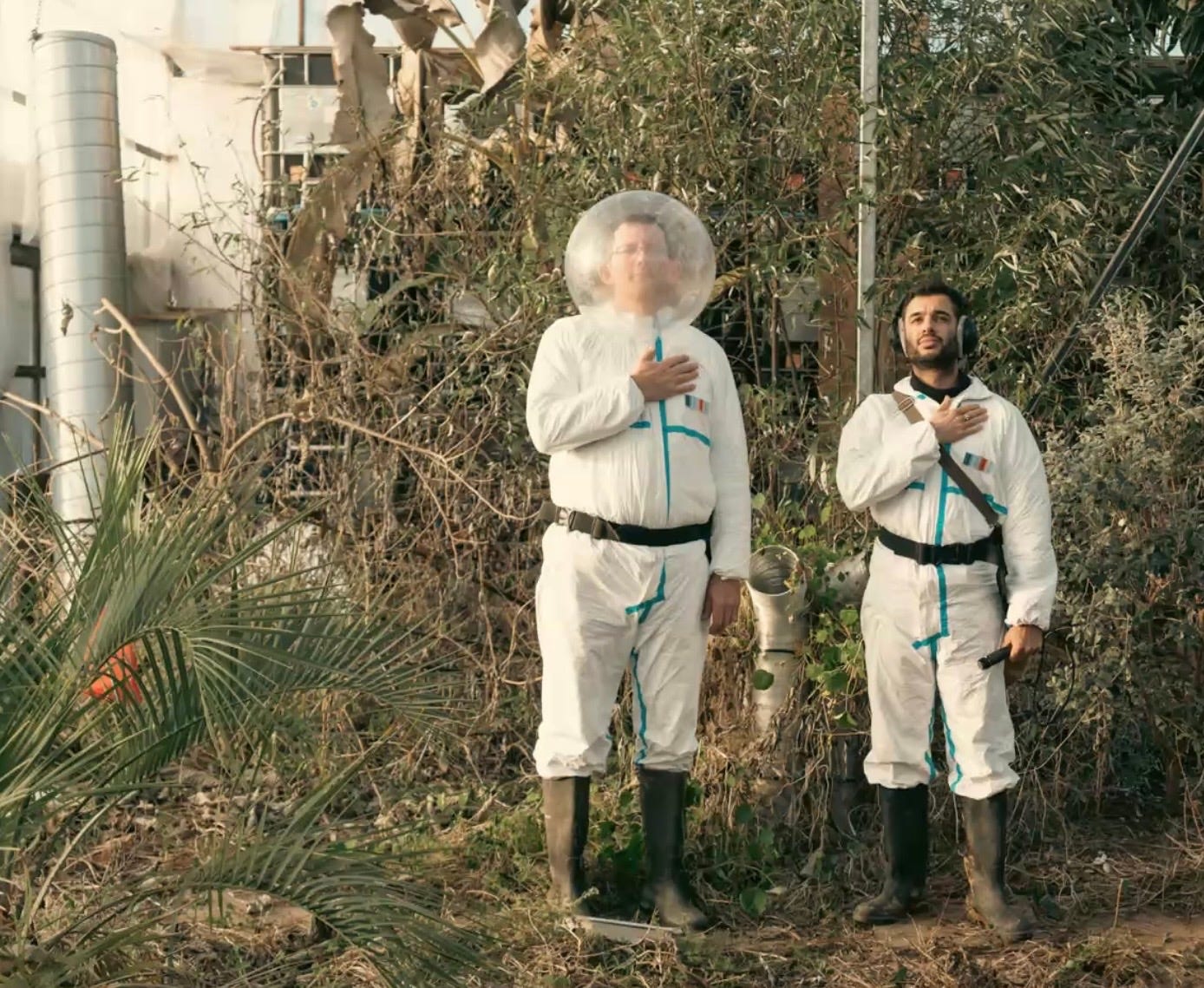
(Copyright: Rob Hopkins, 2026)
What do we learn from these research trips to the future?
The air smells delicious
Apparently, 2036 is quite a nice place. You notice immediately how delicious the air smells and how much louder the birdsong seems to be.
There are bike jams in the cities, but these are easier to manage than the traffic jams they have replaced. Beavers have been reintroduced almost everywhere as environmental managers, paid for by insurance companies to reduce flood risk. The depaving movement (“the liberation of soil”) is in full swing, as schools and councils tear up concrete and tarmac and let the earth below it breathe again, reducing both the risks of flash flooding and urban heat effects. Mycelium is used as a sustainable raw material in the production of a wide range of industrial goods. Local councils have bought up sites in or near their towns and turned them into market gardens, helping them to feed their schools. There’s more.
Of course, there’s a game going on here. He knows that we know that he knows that we know that he didn’t really travel to 2036. All of these things are weak signals of positive change (as in, pro-climate change). At some point he pops up a slide of some of these weak signals, along with William Gibson’s famous quote.
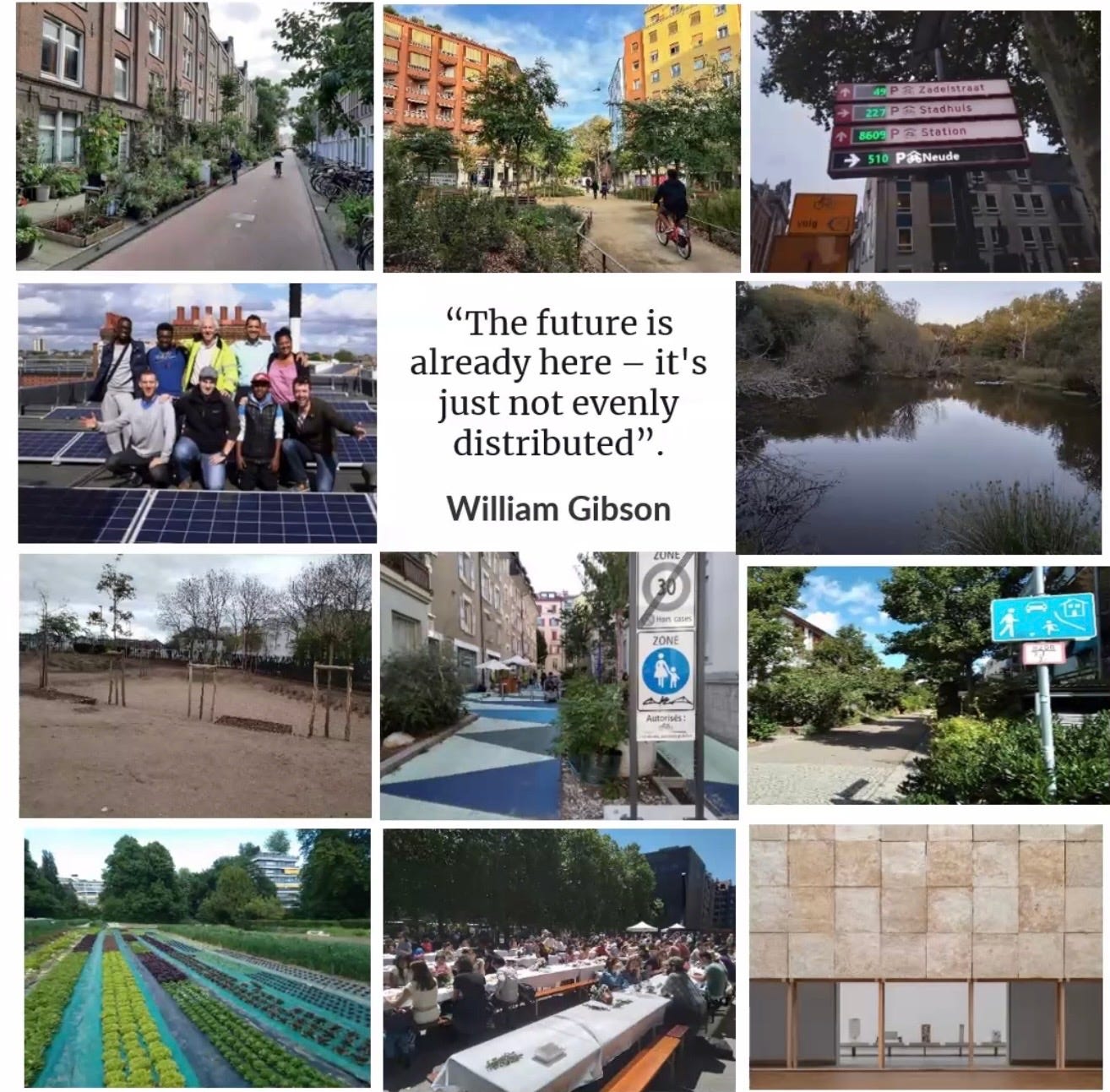
(Copyright: Rob Hopkins, 2026)
Telling the future
But creating positive images of the future is an essential part of creating a positive future, as Fred Polak told us more than 70 years ago.
And that creation of positive images of the future is essentially a cognitive process. The idea of future time travel is a smart cognitive trick to give us permission to explore versions of the future that seem attractive—even at a sensory level—but which get screened out by the relentless dominant discourses of late capitalism. It helps to lift the weight of the present off our shoulders.
Hopkins has been developing other devices to help with this cognitive process. One is a futures-telling machine—like the kind of thing you might once have seen in a fairground—that prints out a short future for you and your community. He says that this creates real excitement (and my colleague David Bent, who has seen it in operation, confirms this), both of anticipation in the queue, and when you get your future printed out and absorb what it says. It becomes an artefact that creates a moment of immersion.
Recordings from the future
Another more sensory device is the Field Recordings From The Future, which Hopkins has developed with his fellow time travelling researcher Mr Kit. These are on Bandcamp, and I am listening to them as I write. They represent audio stories from the future—the ‘radio ballads’ of 2036. Hopkins and Mr. Kit will be touring these as part of a show in the autumn.
A lot of this speaks to some of the work that I have been doing on the role of culture as an engine of change (theoretically, in Raymond Williams’ idea of “structures of feeling”, in creating “a politics of the future”, and more practically, in the AI-supported project The Fizz.)
Several of the questions touched on doing this work in the face of scepticism, perhaps from people who had been bruised by conversations with people who had dismissed the possibilities of change. Hopkins talked of the importance of doing this work slowly, of meeting needs that people recognised as needs (in Totnes, for example, a long-running green community housing project is now reaching fruition), of “sensual futuring”, and of talking about the past as well as the future.
An assault on imagination
He was also asked if people told him he was naïve. His answer was revealing. When he published the Transition Handbook, in 2008, he was accused of naivété. At the time—I think I have these numbers right from my notes—Europe was paying €18 billion a month to Russia for oil and gas. Now we’re spending billions to fortify our defence systems against the military threat of Russia. “Who was the naïve person?”, he says.
Hopkins observes that there’s been an assault on imagination over the past few decades (a theme in the work of the late Mark Fisher)[1]. One sign of this is in the dismantling of arts and humanities courses across the British university system. He quoted Ursula LeGuin to the effect that “the word ‘creativity’ has been so debased by capitalism. But they can’t have ‘imagination’”.
Hopkins argued that “imagination is wilful, mischievous, a bit naughty”. It is also the best way to unlock new forms of longing.
—
The video of the webinar can be seen on Root and Reason’s youtube channel.
—
A version of this article is also published on my Just Two Things Newsletter.
—
[1] Fisher saw this as a necessary functioning of neoliberalism and late-stage capitalism, because one of the ways in which it maintained hegemony was by closing off the future. There’s more there than I can discuss in a footnote. But it does underline that imagining desired and different futures is a radical act.
—
Previously Published on thenextwavefutures.wordpress.com with Creative Commons License
***

If you believe in the work we are doing here at The Good Men Project, please join us as a Premium Member today.
All Premium Members get to view The Good Men Project with NO ADS.
Need more info? A complete list of benefits is here.
—
Photo credit: (Copyright: Rob Hopkins, 2026)

