


America lost an icon last month. During her sixty-year career in country music, Dolly Parton sold over a hundred million records and won countless awards. The tributes and obituaries continued for days afterwards. None focused exclusively on her celebrity. They all talked about her generosity. Throughout her life she supported dozens of causes: medical research, literacy, disaster relief, education, healthcare, all to ease burdens and to better the lives of others.
We generally measure success in terms of accomplishments. Death notices tally up a person’s life in a few paragraphs: birth, education, marriage, a favorite hobby, or travel destination. And for a few years afterward, we write notes on Facebook at birthdays or anniversaries. “Happy Birthday, Dad,” we write. “We miss you every day.”
We do this because we are trying to keep them from disappearing. But genealogy shows us that we all, eventually, will be reduced to names and dates on a family tree. But legacy is not the same as memory.
When my stepfather married my mother, he immediately acquired two high-school aged daughters in the bargain. A brilliant and decorated physicist in his forties, Ernie had never married or had children. Doubtless, we were a lot to take on. But he relished family life; throwing himself into it for decades, much of it while suffering with recurrent cancer. He never complained.
Many years in, my daughter was born weeks early. She would not sleep unless I held her upright, all night, in the rocker. During those first weeks after I brought her home from the hospital, he tapped me on the shoulder at 2 am every morning, as I dozed and struggled to stay upright in the rocking chair. He rocked her for me from 2 until 7 am every morning, when he had to get ready for work, allowing me to grab a few grateful hours of sleep.
Years later, he had his own trip home from the hospital. It was his last. The cancer had metastasized throughout his body, and we had exhausted all treatment options. He withdrew from us then, lost in his own thoughts.
I felt helpless. He had no biological offspring of his own yet own, yet had meant so much to all of us. I wanted to tell him that somehow.
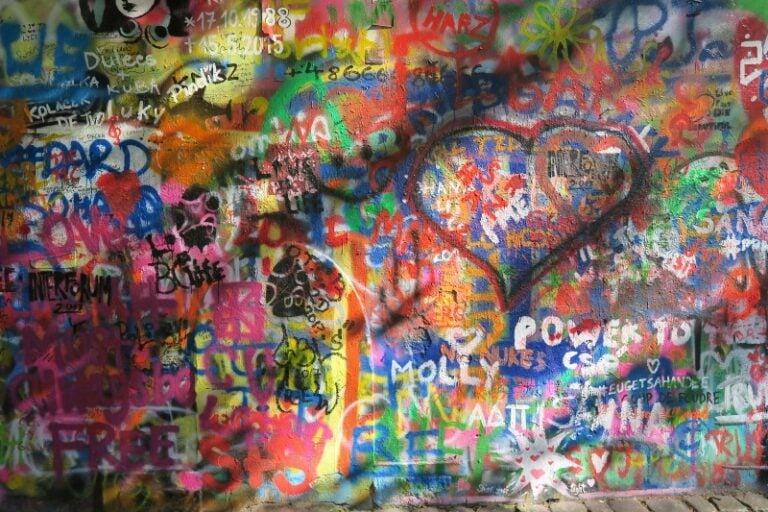
Desperate to do something to convey the message, but unable to find the words, I made him a collage. I searched my albums for photos of him with all of us: playing the guitar for his granddaughters, having a laugh with me at the breakfast table, sharing a hammock with my mom in the garden. In the center of the collage, I placed a photo I had taken in Berlin: a graffiti-covered wall bearing the words, “Where you invest your love, you invest your life.”
I wanted him to know that we were his legacy.
Every day, each of us has opportunities to make another person’s passage through life slightly easier. We listen. We extend patience, or a hand where it is needed. Most of these acts never appear in an obituary or a family history. They usually leave no visible record at all.
Dolly invested her life in millions of people she would never know. Ernie invested his in one family. The scale was different, but the measure was not.
That is what I was trying to tell him with that collage all those years ago. Eventually we will disappear from memory. Our stories will be reduced to names and dates. But something of us remains in the people whose whose lives we eased or enlarged, and in those who were changed, even slightly, for our presence. Maybe that is what counts as a life well spent.
—
This post was previously published on medium.com.
Love relationships? We promise to have a good one with your inbox.
Subcribe to get 3x weekly dating and relationship advice.
Did you know? We have 8 publications on Medium. Join us there!
***
–
Photo credit: Neil Su On Unsplash

