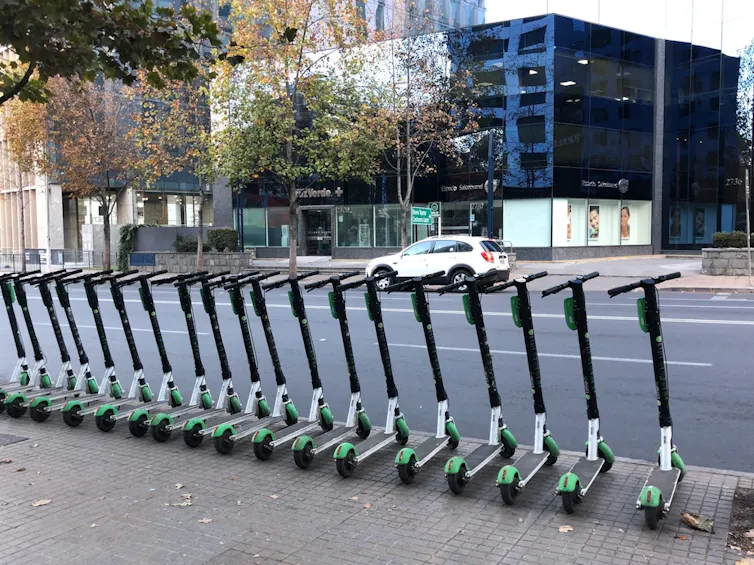
To properly assess these claims, it’s important to consider all relevant environmental factors, including the materials and energy required to manufacture scooters, the impacts of collecting them daily for charging and redistributing, and the electricity that charges their batteries.
I study methods for assessing environmental impacts of products and materials. In a newly published study, I show that e-scooter programs may have larger total environmental impacts than the transportation modes they displace. But if cities update their policies and mobility companies tweak some of their practices, there are opportunities to make e-scooters a greener option.
The electric scooter boom
Anyone who lives in a city or near a college campus has probably seen e-scooters. Designed for short-distance travel, these devices have a small electric motor and deck on which a single person stands. Ride share companies such as Bird and Lime rent out scooters by the minute, and riders leave them at their final destination to be claimed by the next user or picked up later for charging.
In 2017 these programs were rare, but in 2018 riders took an estimated 38.5 million trips on e-scooters. These devices fill a singular niche for some people, solving the “last mile problem” – the last leg of a trip, which sometimes can be the most difficult, since it may mean walking home from a bus stop or train station. Scooters are an alternative to driving and parking a personal automobile, and often are cheaper than a taxi or Uber.
“Your ride was carbon free” – really?
The transportation sector generates nearly one-third of U.S. greenhouse gas emissions and a large share of smog and asthma-inducing pollutants. With no tailpipes to spew emissions, it would be easy to assume that shared e-scooters are an environmentally preferable option. E-scooter companies often tout the environmental benefits of their “carbon-free” and “earth-friendly” rides.
Screen shot from an e-scooter user’s smart phone at the end of a ride. CC BY-ND
Environmental claim from Bird’s web site. CC BY-ND
However, claims of a full carbon-free ride don’t hold up when all of the actions required to have an e-scooter ready, at the right location and charged for use are considered. With North Carolina State University engineering students Joseph Hollingsworth and Brenna Copeland, I turned to a life cycle approach to fill in the gaps.
Hidden impacts
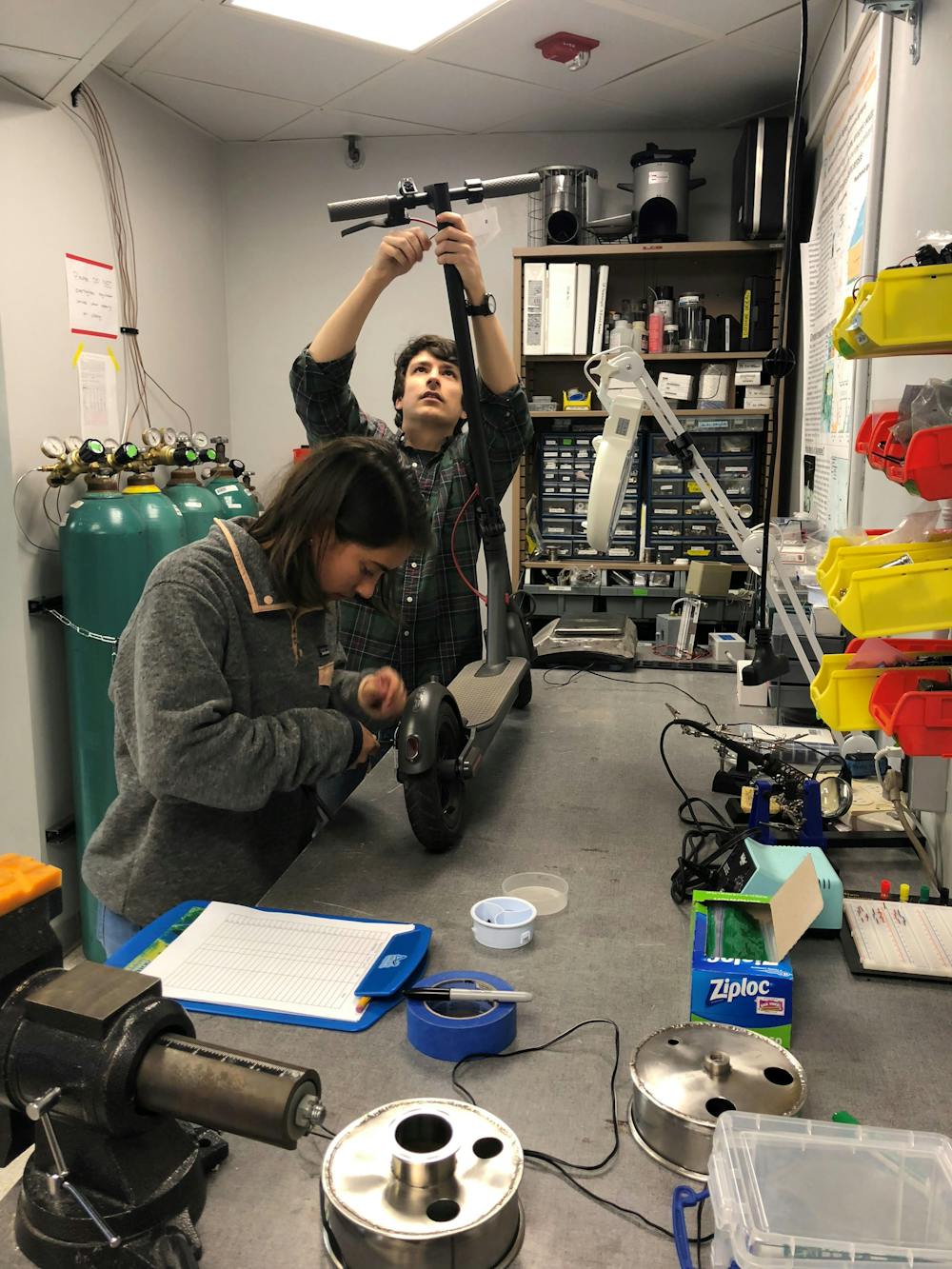
Chinese electronics company Xiaomi manufactures many of the e-scooters used in the United States. To understand what materials go into each scooter, we took one apart and inventoried the 13 pounds of aluminum, 2.5-pound lithium-ion battery, electric motor and various plastic and steel parts.
Manufacturing these scooters and other electronic products has effects at the mine site, the smelter and the factory. For e-scooters, we calculated that these production impacts often exceed half of the total impacts caused by each mile of travel on a scooter.
Shipping e-scooters from China to the U.S., however, has a trivial effect, thanks to the efficiency of the global transportation network.
North Carolina State University students Joseph Hollingsworth and Brenna Copeland disassemble an e-scooter to create a material inventory. Jeremiah Johnson, CC BY-ND
E-scooter companies employ independent contractors to collect, charge and redistribute the scooters to desirable locations. Lime calls these folks Juicers. Their counterparts at Bird are Chargers, and they distribute the fully charged scooters into Nests.
These collectors typically drive their personal automobiles to round up as many scooters as they can, then charge them at home and return them the next day. The logistics are not optimized, which leads to unnecessary driving on the hunt for scooters. We found that this mileage can generate over 40% of the total environmental impacts of e-scooter use.
In contrast, powering e-scooters requires relatively little energy. Charging a fully depleted e-scooter battery uses about as much electricity as running an average clothes dryer for five minutes. And most e-scooter batteries are nowhere near fully depleted when picked up, particularly in cities that require companies to remove scooters from the streets each night. In Raleigh, we found that about one out of six scooters were over 95% charged at the end of the day, but were still picked up for nightly charging.
Vancouver’s plan to achieve carbon-free transportation by 2050 includes urban design and mobility pricing as well as vehicle choices.
Other ways to get there
It is important to consider what e-scooters are displacing when quantifying their relative effects on the environment. Surveys show that about one-third of e-scooter rides replace automobile use, while nearly half of scooter users would have walked or biked instead. About 10% would have taken public transit, and the remaining 7% or 8% would not have made the trip at all.
Our study found that driving a car is almost always less environmentally friendly than using an e-scooter. When only one-third of e-scooter rides displace automobile travel, then the use of e-scooters likely increases overall transportation emissions by drawing people away from walking, biking or taking public transit. However, if e-scooters were to displace car rides half the time, we would expect them to be a net win for the environment on average.
Lightening scooters’ footprint
Our research highlights several ways to make these scooters more sustainable. Using e-scooters that are designed to be more durable can reduce environmental impacts from the materials used to build them on a per-mile traveled basis. Improving collection and distribution processes could reduce driving distances, and companies could use more fuel-efficient vehicles to collect the scooters. For their part, cities could allow scooters to be left out overnight and only picked up when their batteries are depleted.
For now, however, a scooter ride that doesn’t replace a car trip is unlikely to be a net win for the planet.
We are proud of our SOCIAL INTEREST GROUPS—WEEKLY PHONE CALLS to discuss, gain insights, build communities— and help solve some of the most difficult challenges the world has today. Calls are for Members Only (although you can join the first call for free). Not yet a member of The Good Men Project? Join below!
All levels get to view The Good Men Project site AD-FREE.
Register New Account
Please note: If you are already a writer/contributor at The Good Men Project, log in here before registering. (Request a new password if needed).
◊♦◊
ANNUAL PLATINUM membership ($50 per year) includes:
1. AN ALL ACCESS PASS — Join ANY and ALL of our weekly calls, Social Interest Groups, classes, workshops, and private Facebook groups. We have at least one group phone call or online class every day of the week.
2. See the website with no ads when logged in!
3. MEMBER commenting badge.
*** ANNUAL GOLD membership ($25 per year) includes all the benefits above — but only ONE Weekly Social Interest Group and ONE class.
*** ANNUAL BRONZE membership ($12 per year) is great if you are not ready to join the full conversation but want to support our mission anyway. You’ll still get a BRONZE commenting badge, and you can pop into any of our weekly Friday Calls with the Publisher when you have time. This is for people who believe—like we do—that this conversation about men and changing roles and goodness in the 21st century is one of the most important conversations you can have today.
♦◊♦
We have pioneered the largest worldwide conversation about what it means to be a good man in the 21st century. Your support of our work is inspiring and invaluable.
—
The Conversation is an independent news and commentary website produced by academics and journalists, free for the public. Follow on Twitter @US_conversation