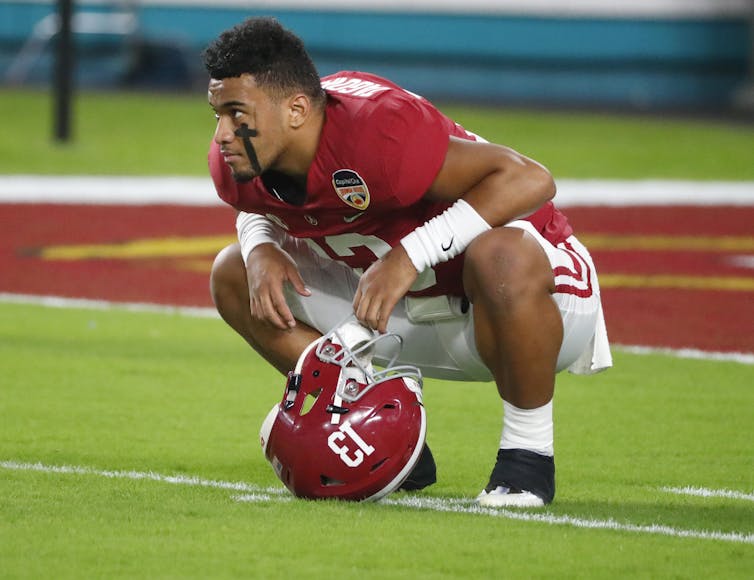
With training camp in full swing, quarterback Marcus Mariota, the first Samoan Heisman Trophy winner, will be the signal caller for the NFL’s Tennessee Titans. Alabama Crimson Tide quarterback Tua Tagovailoa, a pre-season favorite to become the second Samoan Heisman winner, is entering his junior year. His younger brother, Taulia, also a quarterback, has joined him at Alabama. One day, Taulia could very well square off against another Samoan, D.J. Uiagalelei, a top-ranked high school quarterback who committed to Clemson in May.
How did American Samoa – a tiny island territory in the Pacific – become a wellspring of football talent?
Samoans have become the most overrepresented group, per capita, in the NFL. About 180,000 people of Samoans descent live stateside, while another 55,000 live in American Samoa, a U.S. territory. Over the past few seasons, roughly 50 players of Samoan descent have been on NFL rosters – about 3% of the league, and nearly 40 times their proportional share of the U.S. population. The 200-plus Samoans playing Division I collegiate football are similarly overrepresented.
I’ve traveled to American Samoa five times – most recently in October 2018 – to learn more about what fosters this culture of football excellence. Along the way, it’s become clear that the Samoans pay a price for playing America’s game in a style that they call “the Samoan way.”
Football’s existential crisis
Football in the U.S. is at a crossroads. Concern over concussions has caused the percentage of Americans playing Pop Warner and high school football to decline at a steady clip over the past decade. But football, along with rugby, another contact sport, continue to be the most popular among young Samoans in the U.S. and American Samoa.
One reason could be social class, which has become a key indicator of who plays youth football. Samoans lag behind most groups in terms of health, income and education. In Samoan communities, sports are seen as a pathway to a college education and, if players are lucky or talented enough, NFL riches.
Brown University anthropologist and epidemiologist Stephen McGarvey, who studies obesity in the South Pacific, told me that Samoans may be more genetically susceptible to developing more muscle mass, lean tissue and bone mass.
But he can’t say whether that explains their success on the football field. To him, genes matter much less than American Samoa’s unique culture and history.
‘In the way of Samoa’
Since Samoans first arrived in their South Pacific archipelago 3,000 years ago, they’ve lived according to “fa’a Samoa” – “in the way of Samoa.”
“Fa’a Samoa” revolves around mutual obligations and respect for elders, including preachers, teachers – and, these days, coaches. Inculcating youth with a sense of discipline and responsibility, it prioritizes the collective over the individual. For these reasons, success on the playing field is seen as a reflection of family, village and island.
During World War II, Pago Pago Harbor, located in the middle of American Samoa, became a staging ground for Allied troops in the Pacific theater. Samoans became fierce American patriots. The closing of the naval base in 1951 spurred a migration of about one-fifth of the population to Hawaii and the mainland U.S. They brought “fa’a Samoa” with them, even as they tried to adapt to American culture. Their sons and grandsons took to football. Some, like Jesse Sapolu, Junior Seau and Troy Polamalu, would go on to become college and NFL stars.
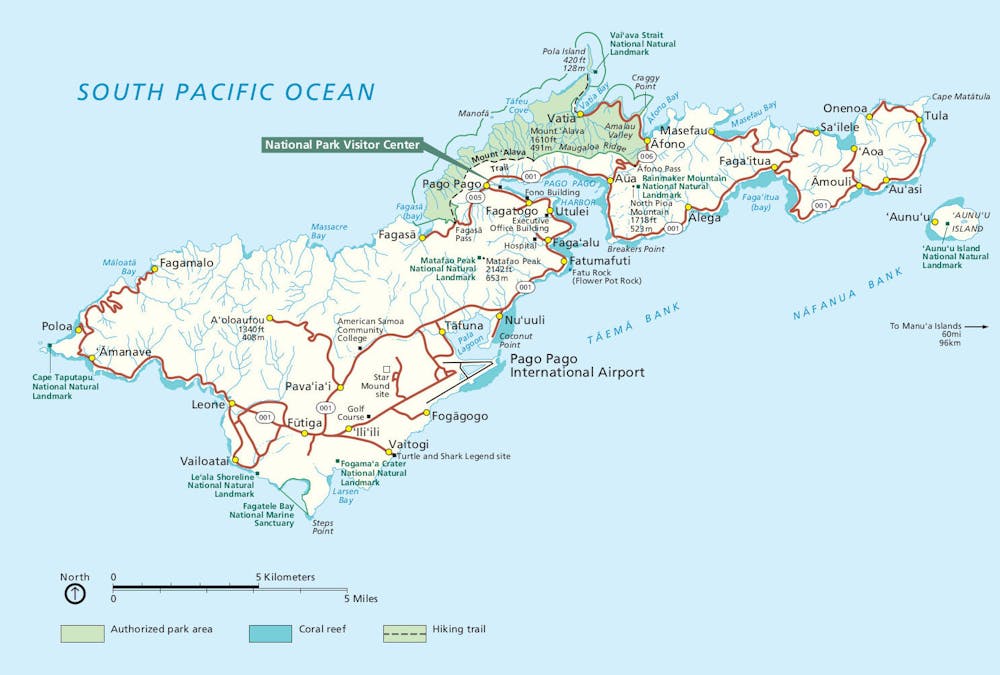
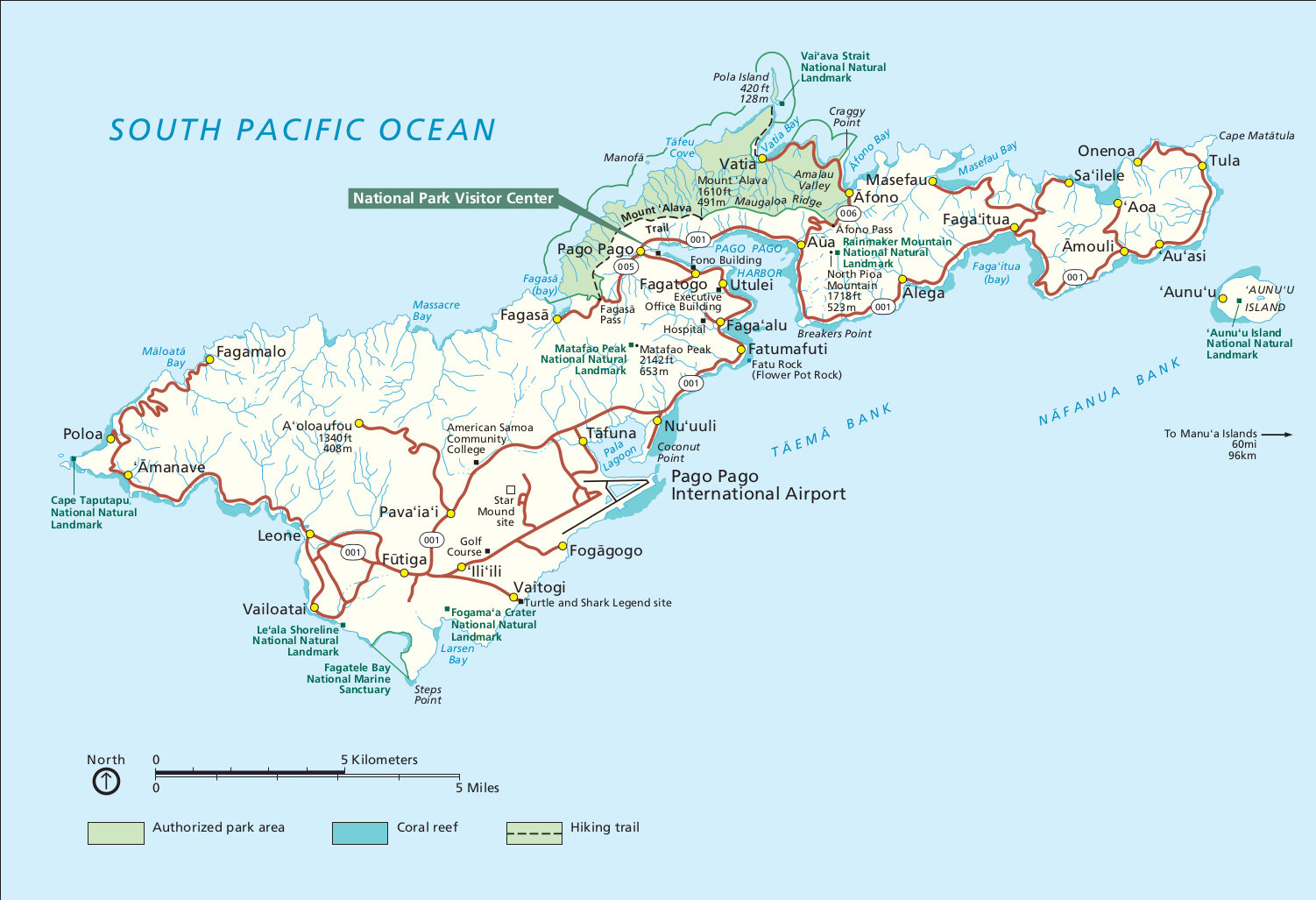
American Samoa has a total land area of 76.1 square miles – slightly larger than Washington, D.C. U.S. National Park Service
Football actually came later to American Samoa. In 1961, Reader’s Digest published an article titled “America’s Shame in the South Seas” that described crumbling government buildings, a polluted bay, and an island rich with natural resources that had been reduced to importing canned goods to cover food shortages. With the Cold War raging, embarrassment over the neglect prompted the U.S. government to pour resources into the territory and build several high schools that fielded football teams.
On the ground in Tutuila
In October 2018, I returned to Tutuila, American Samoa’s biggest island, to watch the territory’s five football teams compete for the island championship and spend time with the Faga’itua High School football team on the eastern end of Tutuila. Most of American Samoans live on Tutuila; a few thousand reside on the three small islands making up Manu’a, 68 miles away.
The Faga’itua Vikings have won more titles than any other team, even though it’s one of the smaller schools and doesn’t even have its own field. The squad practices at Onesosopo Park, a half-hour drive from the school, on a furrowed field filled with puddles and toads.
Boys at Faga’itua can’t stop at McDonald’s after practice like players from Tafuna, their arch-rival from the other side of the island. The eastern side of the island, where Faga’itua is located, has nothing but a few tiny general stores.
During one of my earlier trips to the island, I spoke with one of the team’s defensive backs, Lafaele Simanu. “We still live in our culture out here,” he explained. “We live in our Samoan ways. We’re not allowed to go out at night that long.”
People live in small villages on collectively owned land, and players perform chores on the hillside plantations in the morning and after practice.
“Football,” he added softly, is also “in our culture.”
I saw it in the “siva tau” war dances they perform before games – both a ceremonial gesture and one designed to intimidate opponents. The emphasis on the warrior spirit – and overcoming fears – is part of what makes them excel at football.
Faga’itua’s players aren’t the biggest on the island, but they train relentlessly under head coach Su’aese “Pooch” Ta’ase, the best and most successful coach in island history. Pooch’s Vikings ended up losing to Tafuna last season; but he’s been preparing his squad for the upcoming campaign since January.
This summer, the Vikings travel to Honolulu to play Kamehameha, the school that Princess Bernice Pauhai Bishop endowed for native Hawaiians. They’ve been raising money for the trip through car washes, a Radio-A-Thon and crowdfunding. The Vikings and other teams in the territory lack the resources and facilities that U.S. teams take for granted.
Young Samoan football players seem to be especially exposed to football’s dangers. Another aspect of “fa’a Samoa” involves a refusal to shy away from competition and physical conflict. Boys play on fields where chunks of volcanic rocks rip into flesh; their outdated helmets would have been discarded for safety reasons years ago stateside; and they seem to seek far more contact than U.S. players. Teams don’t administer pre-season baseline concussion tests. Players seem oblivious to the risks. When I spoke to Faga’itua and Samoana’s teams, I asked how many had ever been concussed. Nobody raised a hand.
Polynesians might be the new face of football and the game might have become the story that Samoans proudly tell to the world. But as the dangers of the game become more well-known, there’s a bittersweet element to the narrative.
Don’t like ads? Become a supporter and enjoy The Good Men Project ad free
We are proud of our SOCIAL INTEREST GROUPS—WEEKLY PHONE CALLS to discuss, gain insights, build communities— and help solve some of the most difficult challenges the world has today. Calls are for Members Only (although you can join the first call for free). Not yet a member of The Good Men Project? Join below!
All levels get to view The Good Men Project site AD-FREE.
Register New Account
Please note: If you are already a writer/contributor at The Good Men Project, log in here before registering. (Request a new password if needed).
◊♦◊
ANNUAL PLATINUM membership ($50 per year) includes:
1. AN ALL ACCESS PASS — Join ANY and ALL of our weekly calls, Social Interest Groups, classes, workshops, and private Facebook groups. We have at least one group phone call or online class every day of the week.
2. See the website with no ads when logged in!
3. MEMBER commenting badge.
*** ANNUAL GOLD membership ($25 per year) includes all the benefits above — but only ONE Weekly Social Interest Group and ONE class.
*** ANNUAL BRONZE membership ($12 per year) is great if you are not ready to join the full conversation but want to support our mission anyway. You’ll still get a BRONZE commenting badge, and you can pop into any of our weekly Friday Calls with the Publisher when you have time. This is for people who believe—like we do—that this conversation about men and changing roles and goodness in the 21st century is one of the most important conversations you can have today.
♦◊♦
We have pioneered the largest worldwide conversation about what it means to be a good man in the 21st century. Your support of our work is inspiring and invaluable.
—
The Conversation is an independent news and commentary website produced by academics and journalists, free for the public. Follow on Twitter @US_conversation